
Let us continue the following topic: color and shape.
3. Color and shape
In addition to fonts, large areas of color blocks and geometric lines are also Kubrick's weapons to create a sense of the future.
In the 1960s and 1970s, people believed that "the future is white".
In 2001: A Space Odyssey, large areas of white in the space station, shuttle and discovery spacecraft create a calm and elegant atmosphere for future space navigation.


At the end of the film, Dave Bowman came to the room set up by the higher civilization. The walls and floors are green and white, which superimposes a layer of mystery and weirdness in the sense of technology.

In this "bedroom at the end of the universe", all the white seems to have a faint light.
Later, many movies and TV dramas continued to use similar methods to maximize the sense of the future.

In George Lucas's early THX 1138 (1971), the protagonist dressed in white in the vast space of bright white. It contrasts sharply with villains, the men in black, and the club in his hand.

Elio Petri's The 10th Victim (1964) depicts a futuristic reality show in which contestants spread out in a white geometric space.

Scenes from the sci-fi series Space: 1999 (1975)
PET 2001 is a white all-in-one design, with the display, keyboard and storage devices embedded in the metal shell with trapezoidal lines. It is similar to a video machine in 2001: A Space Odyssey by which Floydtalks to his daughter.


White, one-piece, bright lines, big straight lines and big angles, Kubrick's "clean and elegant" visual style was popular in the 1970s.
Influenced by 2001: A Space Odyssey, PET 2001 also became the aesthetic representative of the computer in the 1970s, and many other industrial products looked the same.
It includes:
In 1981, the first portable personal computer Osborne 1.

Apple's famous Lisa and Macintosh in 1983.

Seiko's first wrist computer, the UC-2000 in 1984.
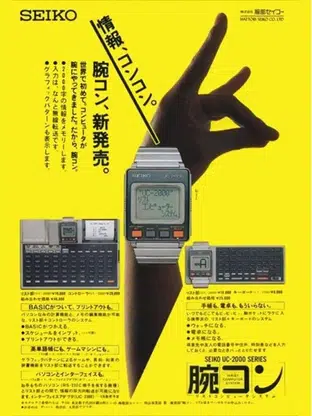
IBM's first laptop, Convertible, in 1986.

In the same year, the Soviet Union also invented a SPHINX system (meaning "Super Function Integrated Communication System"), which is a "revolutionary computer" integrating digital entertainment, communication, telecommuting and telemedicine.

In 1987, an advertisement for SPHINX was published in Technical Aesthetics magazine. The computer was commissioned by VNIITE Design Institute by the Science and Technology Commission of the State Council, which was directly controlled by the Soviet government.
SPHINX has a handsome and avant-garde look, based on simple geometric shapes-rectangle, triangle, sphere, white, yellow, orange, blue and cyan, which are inspired by aerospace design. Unfortunately, the project was aborted prematurely and there was no mass production.


The "core" of SPHINX is a triangular CPU and three memory expansion modules. Lots of cool peripherals included: flat panel display, dome speaker, handheld remote control with small LCD screen + microphone + speaker, wireless headset, smartwatch, AR glasses/Technical Aesthetics Magazine, MCM.
In the early eighties, another Dutch manufacturer introduced a little-known microcomputer, the Holborn 9100. It also had a white unibody design and a plastic shell, but the display was very unique, which poked out like a periscope.

Advertisement of Holborn 9100

Design drawings for Holborn 9100
It's sleek, organic. If it is a prop from 2001: A Space Odyssey, it's not out of place.





Share your thoughts!
Be the first to start the conversation.