
Charlie
If there is something that never goes out of style, fairy tales must be one of them. As long as our childlike innocence endures, fairy tales will continue to thrive.
It's safe to assert that you'll never encounter another American director with a penchant for gothic fairytale fantasy quite like Tim Burton, or an actor who works as well with Burton as Johnny Depp does. The duo have never let us down. Charlie and the Chocolate Factory is a classic film, a whimsical journey for children and a vibrant visual feast for adults.
Today, let's delve into the triple contrast set by Tim Burton in this film.
First Contrast: Charlie and the Chocolate Factory - Family is Wealth
At the heart of this fairy tale lies the significance of family, veiled in enchanting hues. It is also the theme that Tim Burton aims to express through this film.
The first contrast set by Burton in the film is evident in its title: Charlie and the Chocolate Factory.

The protagonist, Charlie, is an ordinary boy who is not notably smart or strong. He is born into a family where even basic needs are a struggle. Their house is fragile, barely enduring the harsh winter. At first glance, it seems Charlie lives in a gloomy home on the verge of collapse due to poverty. However, Charlie is actually the luckiest boy in the world because he possesses a rare treasure: the love of his family.
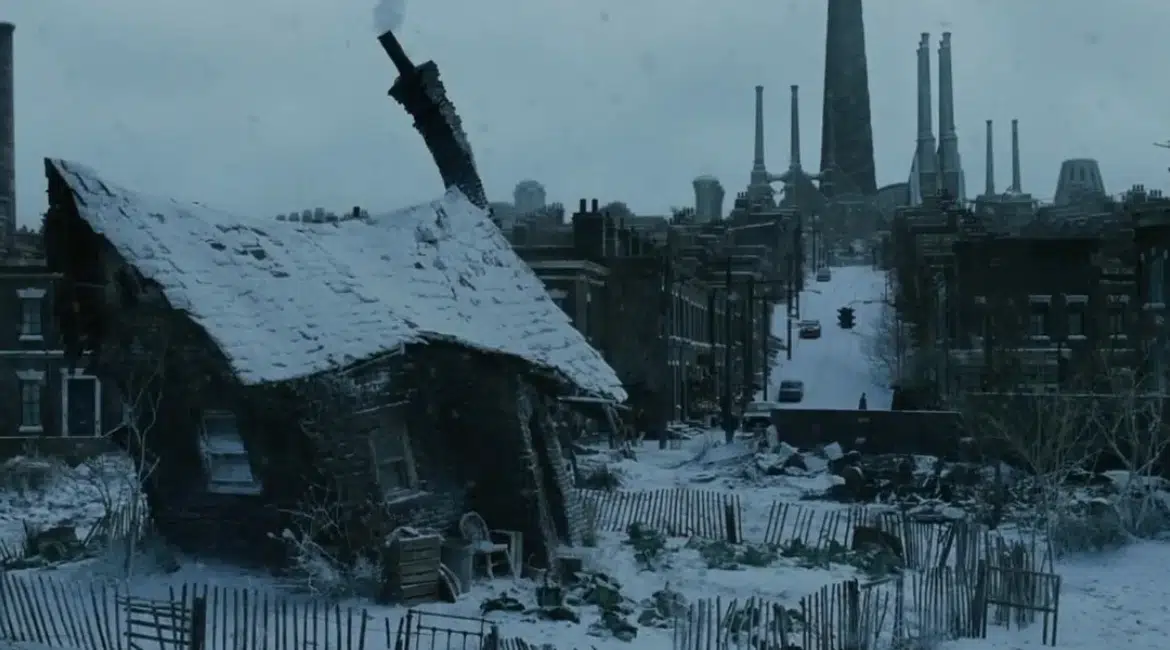
The warmth in their small home is enough to melt the harshest winter. Charlie's mother works tirelessly to prepare a modest dinner for the family. Even when they can't afford a proper meal, she would laugh and tease that 'collard greens and kale are the best,' trying not to let Charlie face the bleakness of life.
Due to the limited space at home, Charlie's grandparents share one bed. Yet, their witty remarks and childlike spirit make Charlie laugh.
Charlie's father, who works in a toothpaste factory, is paid so little that he can hardly make ends meet. However, he always manages to bring Charlie some surprises: discarded toothpaste caps become Charlie's 'Lego blocks'. Charlie builds an exquisite model of the chocolate factory with these caps—father's love grants Charlie the right to dream.
Within Charlie's heart, the chocolate factory embodies his dream realm—a place adorned with all the candies and chocolates that every child yearns for, and a haven where he holds profound admiration for a chocolate genius.
In contrast to the ordinary Charlie is the magical and whimsical Chocolate Factory. Willy Wonka, the owner of the factory, is a legendary master in chocolate-making and he is full of fantastical concepts—ice cream that never melts, a chocolate palace, and bubble gum capable of inflating to infinite sizes. Wonka's chocolate packaging is exquisite, and its taste is so alluring that whenever his chocolates are seen in any store worldwide, they are immediately sold out.

Regrettably, owing to an episode of industrial espionage, the doors of the factory have remained tightly shut for 15 years. No one has ever been seen entering or leaving through the doors during this time. Nevertheless, the rich chocolate continues to be sold worldwide and is beloved by children.
Charlie and the Chocolate Factory appear as two contrasting symbols. Charlie represents poverty and ordinariness, while the Chocolate Factory represents wealth and extraordinariness. However, on a deeper level, the significance both carry are quite the opposite.
Charlie's material life may be impoverished, but the love of his family brings him spiritual wealth. In his spiritual world, Charlie is a millionaire. The love he possesses heals the wounds of life. On the other hand, despite the apparent glamour and material wealth of the Chocolate Factory, Willy Wonka is lonely, cold, and shrouded in a melancholic tone. His heart is filled with unknown pain, just like the tightly shut doors of the factory. Over the years, his inner emptiness grows, and material wealth cannot rescue him from the poverty of the spirit. He is extraordinarily deprived and poor in this sense.
In the spiritual realm, Charlie, surrounded by his loving family, embodies true wealth.
Second Contrast: Charlie and the 4 Other Lucky Ones - Having Family ≠ Having Love
In Charlie's life, a compassionate and optimistic family is synonymous with love—a formula that remains true. Yet, for the four other central characters in the movie, their familial situations are not as favourable.
A crucial plot in the film is that children with golden tickets can visit the chocolate factory with their families, and there are only five golden tickets. Tim Burton masterfully crafts the second contrast through these five tickets, sharply satirising four different family models.

As the golden tickets appear one by one, the mysterious Chocolate Factory unveils itself: Chocolate waterfalls, towering mushrooms, pumpkins filled with pink jam—what unfolds in front of us is a fairy tale, a sight where everything is crafted from sweets. Even the grass on the ground is edible. We can't help but marvel at the imagination in the film. What everyone doesn't know is that this beautiful fairy-tale world is the testing ground for the five children and their parents.
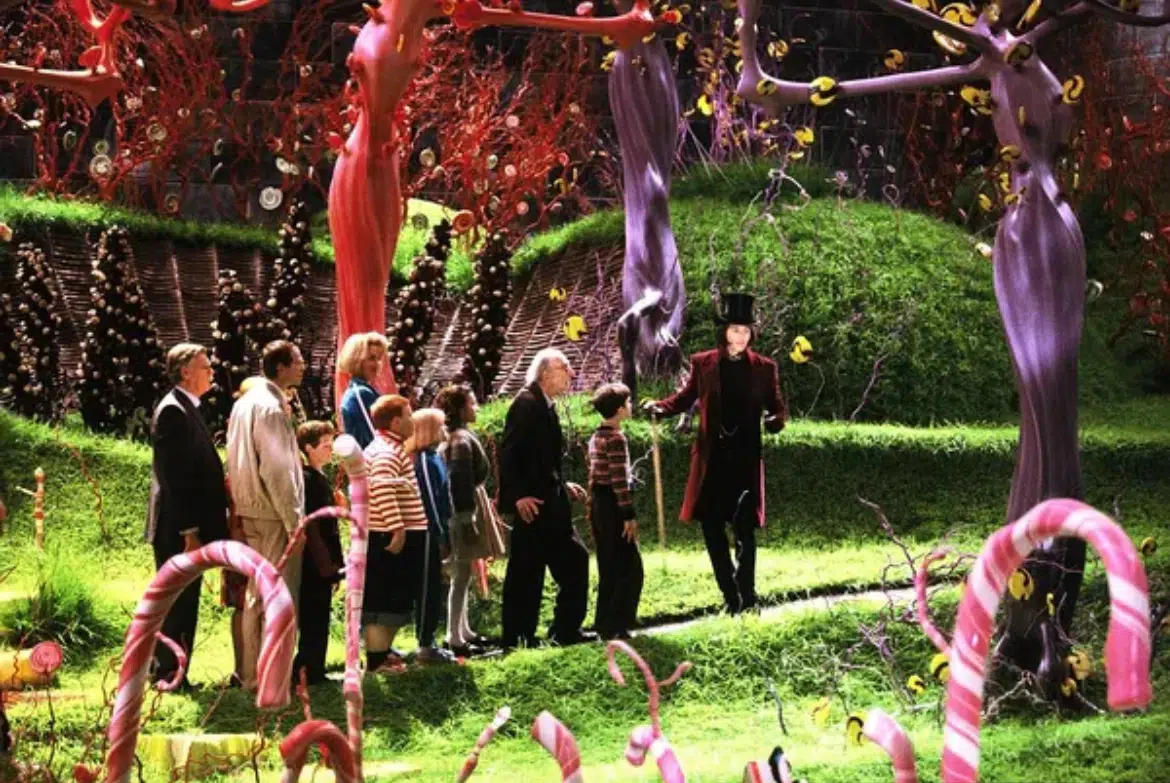
In this unconventional assessment, the permissive family is the first one that fails.
Augustus is a greedy child from a newly rich family. He eats copious amounts of sweets every day and even has chocolate smeared on his mouth during interviews. Upon entering Willy Wonka's Chocolate Factory, the chubby boy treats it like a gold mine. Everything before him is food. He acts like a starving beast, grabbing handfuls of cream and stuffing grass from the ground into his mouth.

The consequence of this indulgence is evident when the gluttonous boy nearly drowns in the chocolate river and gets stuck in the drainage pipe.
Augustus's mother, who has always connived at his gluttony without any restraint, is the main culprit responsible.
The second one that fails is the competitive family.

Violet is taught by her mother to be a 'champion daughter'. Her life motto is all about being a champion. Her primary motive for wanting the golden ticket is not because she loves chocolate or sweets or longs for the mysterious Chocolate Factory. She is there for the grand prize stated on the ticket and is confident to win it. During the factory tour, Violet ignores warnings and chews an experimental gum in her competitive spirit, ultimately turning into a giant round blueberry.
Nevertheless, she wouldn't have eaten the gum if it weren't for her mother constantly fostering her competitiveness.
The third type of family that fails is the overly-doting family.

Veruca's father owns a nut factory, and he unquestioningly fulfils all of his daughter's demands. So, when Veruca says, 'I want my golden ticket, ' he orders all the factory workers to stop their work and unwrap chocolate bars. However, Veruca endlessly asks for the next gift once she has the golden ticket.
In this dreamlike Chocolate Factory, the girl continues her demands. To get a squirrel, she sneaks into the squirrel's workplace and ends up being thrown into the garbage dump.

The factory owner is the one who spoiled his daughter and taught her nothing but taking everything for granted.
The fourth one that fails is the neglectful family.
Mike is a violent boy without innocence. He has a high IQ and enjoys violent video games. By manipulating dates of manufacture and weather reports, he manages to get a golden ticket on his first try buying a chocolate bar. Ironically, he despises chocolate.

Once in the factory, Mike indulges in destructive behaviour, with his father watching helplessly and choosing not to intervene. Eventually, the father is powerless to stop Mike from entering Willy Wonka's television transporter, turning into a palm-sized little person. This is the result of neglectful parenting.
Compared to these four families, Charlie's family consistently encourages him: they don't let him give up searching for the golden ticket due to slim chances, they don't let him lose confidence due to poverty, and they try not to let him suffer from apathy or reprimand from the hardships in life.
By showcasing this second contrast, the director tells us that whether poor or rich, you can only gain true love from a family that loves you; one that doesn't condone your wrongdoings, a family that doesn't spoil you; one that doesn't set you against others, and a family doesn't neglect you.
Due to the influence of such a family, Charlie maintains a purity of character, kindness, and gratitude. His exemplary qualities ultimately render him the sole victor in this experiment.
Third Contrast: Charlie and Wonka - Family is More Important than Wealth
Kind-hearted Charlie finally receives his prize at the end of the movie. Willy Wonka offers to give the Chocolate Factory to him, but with a condition: Charlie must abandon his family and move to live in the factory. In this dilemma, the director stages the third contrast for us: family versus wealth.
Charlie chooses his family without hesitation because he has a happy and warm home. In contrast, when faced with the choice between family and wealth, Willy Wonka is forced to choose wealth.
Willy Wonka's childhood was not as fortunate as Charlie's. His father, a dentist, deprived him of eating even a single piece of candy due to his professional beliefs and even forced him to wear exaggerated braces. However, Wonka dreamed of becoming a chocolate inventor. Eventually, the young boy left home with resentment towards his father.

Years of wandering have made Wonka unfamiliar with the concept of family. He can't even bring himself to utter the word 'parents' and asserts, 'I had no family, and I'm a giant success,' in a cold and indifferent manner.
But is it really so?
In the film, his 'aphasia' has betrayed him. Despite his assertion that 'I had no family,' deep inside, there is a little boy yearning for an embrace. In all those years away from home, he never forgot a word or deed from his father.
Therefore, Willy Wonka eventually accepts help from Charlie. Willy Wonka finally chooses to go home in Charlie's company. When Wonka stands near his home, he realises that only his house remains on the vast white land. His father has been waiting for him all these years patiently. Wonka's arrival marks a long-awaited reconciliation between father and son. After many years, they finally embrace each other.

At last, we witness the best ending: Charlie wins the Chocolate Factory, and Willy Wonka receives a more significant gift—family. During the harsh winter, the warmth of family proves to be the most comforting, and no amount of wealth can rival the companionship of loved ones.





Share your thoughts!
Be the first to start the conversation.