
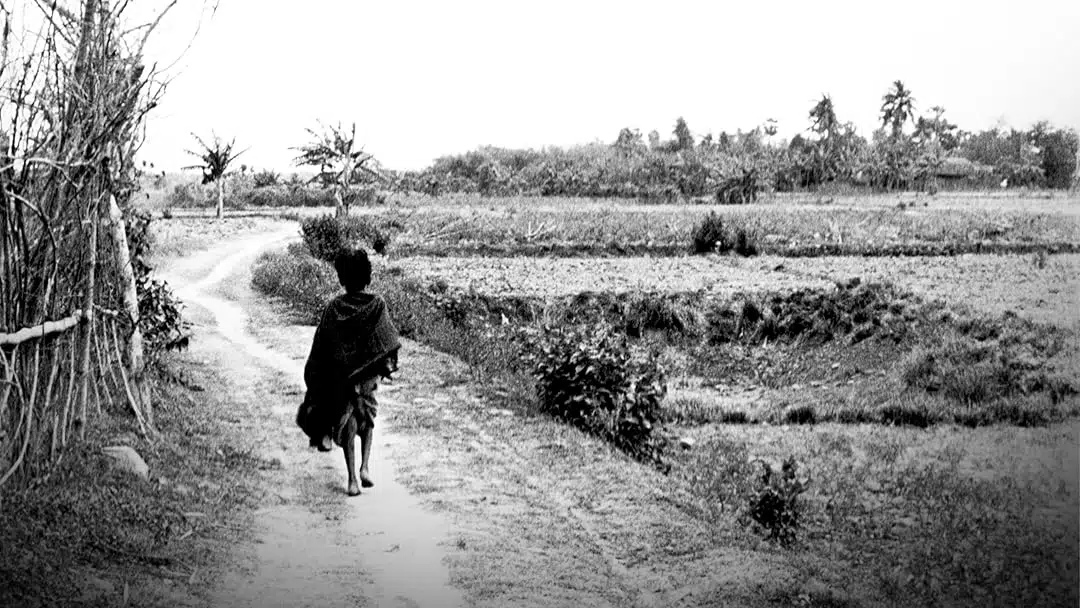
Chances are, unless you’ve fallen down a “Top 100 World Cinema” rabbit hole or hoard Criterion DVDs like trophies, Pather Panchali might not be on your radar. I’m not above it—I fall into the latter group. I’m Indian, and Bengali at that, and while I always knew who Satyajit Ray was, I didn’t really watch his work until embarrassingly late. When I finally did, the 1st thing I realized was how grounded the film is in its portrayal of poverty in India. And not the kind of poverty we usually see in films: loud, tragic, designed to elicit pity—but something quieter. Something lived-in.

Pather Panchali came out in 1955, but it takes place in a small Bengal village around the 1910s. That choice is intentional. India was still under British rule, and rural areas like Nishchindipur were cut off from modern infrastructure and emerging middle-class cities. What we see in the film is a family barely scraping by. The father, Horihor, is a priest and a dreamer, someone who wants to write plays but can’t afford to dream for too long. His wife, Shorbojaya, holds the household together in the way a lot of women did: by sacrificing her own desires. They live with their daughter Durga, who’s often blamed for stealing fruit, and an elderly relative, Indir Thakrun, who’s more of a burden than a blessing, at least to Shorbojaya. When Apu is born, there’s a flicker of hope, but it doesn’t last.

Pather Panchali doesn’t really formulate big arcs or tie up plot threads in digestible ways. Things happen the way they happen in real life: slowly, sometimes without warning, and often without justice. Horihor disappears for months to look for work. Durga gets sick. Indir, the grandmother whom I felt the most sadness for, dies quietly. Nothing about the film is theatrical, which was kind of the point. Indian cinema at the time was full of melodrama and over-the-top acting. Ray, who had never directed a movie before, decided to go in the opposite direction.
He borrowed a lot from Italian Neorealism, especially films like Bicycle Thieves, which captured post-war desperation with a similar stripped-down realism. But while those films focused on Europe, Pather Panchali turned the camera on pre-independence India, on villages and people that the world, and even urban Indians, rarely saw. Ray once said that he paid special attention to detail, and it shows. He used sound and imagery not to explain, but to suggest. A crumbling wall, a pond, a power line, all of it means something, but nothing is underlined. He trusted the audience to figure it out in a sea of melodramatic clichés. In a way, it was pretty risky to take this route, as most viewers were used to watching melodramatic family dynamics so formulaically. I know my grandmother still does, soap operas are her daily scripture.

Take the scene where Shorbojaya enters a wealthy neighbour’s home after Durga is accused of stealing fruit. Ray quietly shows a stone lion statue by the gate, just for a few seconds. That’s all we need to understand the power dynamic. These people have enough to build a statue; Shorbojaya is there to ask for mercy. Later, when Horihor returns with a job and a few gifts, the conversation unfolds in a single frame, with baby Apu swinging between them.
There’s a sense of closeness and distance packed into that shot. That kind of framing carries the emotional weight in the film. When Indir is asked to leave the house, she stops to water a plant on her way out—nothing is said, but everything is implied. Her worth is measured by her usefulness. A dog sits in the foreground of the shot, watching her as she walks away. In that moment, she’s closer to a stray than a family member.

As much as I felt frustrated with the mother, Shorbojaya, who treated her sister-in-law with such coldness, I couldn’t really blame her, or anyone else in the family, for their behaviour. It was a difficult time, and survival often came at the expense of compassion. Resources were scarce, and the mindset was very much “every family for themselves.” After generations of giving up land, livelihood, and autonomy to colonial hierarchies, it was hard to find the space, or the humility, to help those suffering even more than you.
Traditional Indian family values are rooted in a kind of collective survival, where everything, income, food, decisions—is shared. That system made sense until it was slowly hollowed out under British rule. The expectations remained, but the resources didn’t. Ray seems to tap into that contradiction: a family that’s meant to function communally but is slowly breaking apart under pressure. He doesn’t frame the story as one of national pride or resilience, he frames it as a tragedy worth observing.

The most well-known part of the movie is the train scene. Apu and Durga walk through a field of tall grass to watch a train for the first time. Durga places her head on a metal pole to feel the vibrations. This is the first moment the film touches on industrial progress. There’s no direct commentary, but the contrast is clear: the train exists in a different world, one that the kids can only witness from the sidelines. The smoke it leaves behind looks almost like a warning, beautiful, but distant.

In post-independence India, especially around the 1970s when Indira Gandhi launched her “Garibi Hatao” (Remove Poverty) campaign, there was a national push to show progress and development. You’d think a film like Pather Panchali, which aired India’s rural poverty to the world, might be censored or criticized for damaging the country’s image. But that didn’t happen. In fact, Indira Gandhi admired Ray’s work, even though Ray didn’t hesitate to critique society through his films. It’s strange to think about today, when any criticism is met with defensive nationalism or outright censorship, whether it's a BBC documentary being banned or filmmakers being vilified for touching on uncomfortable truths.
Watching Pather Panchali now feels like a reminder of what Indian cinema could have been—and sometimes still is, in rare cases. Since its release, Indian cinema has exploded, producing well over a hundred thousand films, many driven by spectacle or escapism. And that’s fine, to a point. But Ray chose to observe rather than dramatize. He didn’t ask us to cry; he showed us why the characters did. It worked because entire generations who were forced to swallow their pain during these times could embrace with one single moment of compassion.
![Pather Panchali – [FILMGRAB]](https://img.peliplat.com/api/resize/v1?imagePath=peliplat/article/20250516/5f1c59ba88817a3be1b9b9669b5f93f7.jpeg&source=s3-peliplat)
The way Pather Panchali handles poverty is also worth comparing to more recent depictions. Films like Slumdog Millionaire or Lion gained international attention, but they often filtered poverty through a Western lens. The camera lingers a bit too long on suffering, or the story leans too hard on “escaping” poverty as the only happy ending. Ray’s film doesn’t present poverty as a problem to be solved, but as a condition to be understood.
That might be what makes Pather Panchali so timeless and infinitely rewatchable in a contemporary climate: it doesn’t ask for pity, only presence. There’s been criticism noting the fact that Pather Panchali was meant to be poverty porn of sorts, but I don’t think Ray was trying to push an agenda, he just wanted to show the lives of people like Apu and Durga in the most honest way possible. And he trusted that was enough.

In the final act of the movie, Durga dies during a storm. There’s no dramatic monologue about life and death, no soaring score. The storm drowns everything out. Afterward, the family prepares to leave the village. Apu pauses, steps outside, and then turns back to grab an umbrella. That small gesture says everything about how he’s changed. Rain used to be a source of wonder, magic, and innocence. Now, it’s something to brace against.
When I watched this film for the first time, I couldn’t believe my eyes. Even with its minimal budget, amateur actors, and limited resources, Pather Panchali left such a colourful imprint on me. You really wonder how Ray, with almost nothing, pulled off lighting and composition choices that feel as artful and deliberate as anything in cinema, decades ahead of their time.
I watched it with my Bangladeshi friend, and though we came from different backgrounds, we couldn’t help relating to so many of the Bengali family dynamics we saw on screen. We laughed and cried about them afterward, shared memories, shared language, shared expressions passed down through generations. Despite the border that now divides us, we were both watching a story rooted in a time when Bengal was still whole.
So yeah, I’m really glad to have finally gotten around to having an almost spiritual experience in a movie. It reminded me that if you can dream it, and if you’re willing to sit with the uncomfortable truths, you can film it. At the end of the day, this isn’t a movie about escaping hardship. It’s about living with it, noticing it, and holding on to whatever moments of beauty you can find in between. Ray found poetry in the mundane, and through that poetry, he gave poverty a kind of dignity that cinema rarely affords.

BTW: You can find the entire film on YouTube





Share your thoughts!
Be the first to start the conversation.