
On September 12, 1919, the famous Italian poet Gabriele D’Annunzio arrived at the Governor’s Palace in Fiume — now known as Rijeka and part of Croatia — and delivered his “occupation speech” to the residents of the city. In the 2025 documentary Fiume o Morte! (literally translated as “Fiume or Death!”), the camera slowly pulled back from a reenactment of this historic speech, revealing several modern-day cars passing by on the street outside the palace. A voiceover added, “Due to health issues, D’Annunzio’s first speech was actually read on his behalf by a sanitation worker from the city council — though he normally didn’t speak Italian.”

The film then cut to a static black-and-white historical photograph. Beneath the palace balcony, a dense crowd gathered, having heard the news. Then, the scene shifted again — this time to the edge of a parking lot at the film set, where two solitary figures stood. They were playing the roles of D’Annunzio’s wife and son, who were there to cheer him on.
It was immediately clear that Fiume o Morte! was a film full of playful, parodic spirit — or, alternatively, one might call it a boldly experimental work. As a documentary, it not only refused the constraints typical of serious non-fiction cinema, but also openly embraced reenactment and staged performance, even dedicating significant screen time to the very process of staging itself. In doing so, it created a deliberately absurd intertextuality with history.
The historical episode itself was already absurd enough. Fiume was occupied in 1919, shortly after the signing of the Treaty of Saint-Germain on 10 September.The treaty marked the dissolution of the Austro-Hungarian Empire. Led by the icon of the Belle Époque, a group of Italian nationalist irregulars swiftly took control of the city. Hoping to respect the international treaty and avoid an annexation of Fiume, the Italian government ordered the occupiers to withdraw. Instead, D’Annunzio and his radical followers declared Fiume an independent state: the Italian Regency of Carnaro. The occupation lasted more than a year. By late 1920, D’Annunzio went so far as to declare war on Italy. The Italian army responded with a full-scale assault on Fiume, and after three days of bombing, the self-proclaimed regency surrendered. D’Annunzio returned to Italy to live out his days in retirement and never set foot in Fiume again.
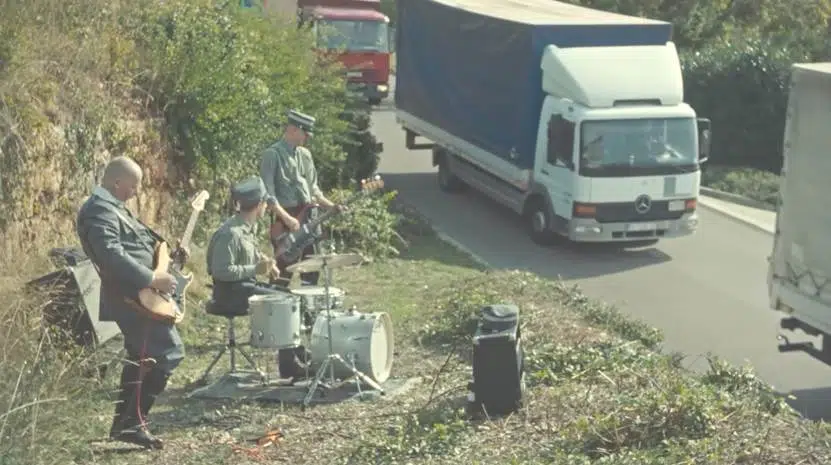
The scenes depicting the nationalists’ advance into Fiume and their tense standoff with the Italian regular army were rendered in the documentary in a uniquely playful and avant-garde fashion. Using hand-drawn reconstructions by later generations, director Igor Bezinović played the army commander himself, while D’Annunzio was portrayed by the lead singer of a Croatian rock band. Faced with the poet’s resolute claim to Fiume’s sovereignty, the regular army chose to retreat, unwilling to harm fellow Italians. D’Annunzio then climbed a hill, grabbed an electric guitar, and broke into a heavy metal performance with his band, brimming with aggression.
The film also included interviews with citizens of Rijeka who were asked to play D’Annunzio in different scenes. Some spoke fluent Italian, some used the Fiuman dialect, and some spoke only Croatian. Even the documentary’s explanatory voiceover lines were read aloud by the director’s family and friends. The film revealed through later battle scenes and prosthetic wounds that the crew had more than enough resources — and skill — to produce a conventional war film. But they deliberately chose a mode that blurred the boundary between fact and fiction.
On Christmas Eve in 1920, full-scale fighting broke out. At first, it was played for laughs: a few ambushers hid on the hillside, launching fireworks from the city. But this soon transformed into full-on immersive role-play, complete with battle choreography and special effects.
This brought to mind American director Joshua Oppenheimer’s The Act of Killing (2012), another documentary that fused testimonial remembrance with experimental reenactment. In it, surviving perpetrators of the 1965 anti-communist massacres in Indonesia — men who were never held accountable — were invited to reenact their own crimes on camera. Through this strange cinematic ritual, they were made to “die” and come face to face with the ghosts of the communists they murdered. In one surreal scene beneath a majestic waterfall, a victim’s specter stepped forward and said, “Thank you for sending us to heaven.” What began as guiltless bravado collapsed into grotesque catharsis: in a simulated death scene, a killer ended up vomiting from the sheer horror of what he’d done.
Compared to The Act of Killing, Fiume o Morte! dealt with events far more distant in time. No living person remembers the original occupation of Fiume, which allowed the filmmakers to approach history with a certain levity — a playful, imaginative retelling of a profoundly absurd episode.

Following the occupation of Fiume, D’Annunzio invited potential Italian investors to survey the city, promising to hand over local industries to them once it officially belonged to Italy. At each proposed project site, the voiceover coolly recounted what actually became of these once-promising opportunities: Porto Baroš was leased to German developers and is now preparing to welcome 230 luxury yachts; the Fiume container terminal was rented out to Danish and Filipino firms; the oil refinery shut down completely; homes around the Gulf of Carnaro were converted into guesthouses; the Danube Shipyard, once a proud symbol of the Yugoslav socialist industry that could build twelve ships a year, was renamed “May 3rd Shipyard” in honor of Fiume’s 1945 liberation — today, it manages only one every three years.
D’Annunzio’s flamboyant Charter of Carnaro, written in high poetic style, later influenced the ideological framework of Italian fascism. He was often described as a precursor to the ideals and practices of Italian fascism and a model for Benito Mussolini, the founder of fascism — despite D’Annunzio never formally identifying himself as a fascist.
And yet, much like a fascist dictator, a great artist often seeks to exercise absolute control over his creations. D’Annunzio ruled over his poetry, his novels, his battles, his self-authored constitution, and his short-lived Regency of Carnaro with the same iron will — with a fierce and focused authority that bordered on artistic despotism.
The documentary toyed with this obsessive seriousness, presenting it as a kind of real-life role-playing game in which D’Annunzio was both the gamemaster and MVP. In his final days, the great poet, who once played history like theater, repeatedly moaned, “So boring.” He’d grown weary of his own game of dictatorship — a game that was later taken up with deadly seriousness, by Mussolini, Adolf Hitler, and Hideki Tojo. And the cost of that game? Over 61 million lives lost across the globe.

Even today, in some places, people are still playing the game — some perhaps in jest, others in genuine expression of fascist ideals. Years ago, while passing through Pordenone, a city in northeastern Italy not far from Fiume, I stumbled upon a grand parade of neo-fascists. At first, I mistook it for some kind of festive celebration — the slogans were in Italian which I couldn’t read. Curious, I got closer, and after being pulled into a group photo by Blackshirts, one of them leaned in and warned me sternly: “We are fascists. You’d better step away.”
During the shooting of one of the battle scenes in Fiume o Morte!, one of the young actors playing a D’Annunzio rebel, who was defending the city, was scolded by an elderly local woman passing by: “[D’Annunzio’s army] was just a bunch of troublemakers. You’re such a handsome young man. What a shame to see you in this uniform.” After filming wrapped, the crew packed up and left. Today, in Rijeka, there are no visible traces of D’Annunzio’s occupation. Nothing remains of his legacy — except perhaps a fading graffiti bearing the large words “Long live Mussolini” tucked away in a mountain cave on the outskirts of the city. And written beneath it, in smaller script, is “Long live D’Annunzio.”





Share your thoughts!
Be the first to start the conversation.