
It’s unsurprising that many of the greatest TV episodes of all time are finales. Even when a series’ quality has wobbled, its showrunners will try to stick the landing – after all, as Game of Thrones has shown us, leaving a sour taste in your audience’ mouth can lead to near total cultural irrelevance not long after the last episode airs.
Twin Peaks pulled this off with aplomb in 1991 after a period of decline that began when visionary director David Lynch functionally left the project due to disputes with ABC, and ended upon his return. ‘Beyond Life and Death’ is a phantasmagoric dive into elements of the show only hinted at previously, embracing Lynch’s trademark surrealism with both hands, and remaining one of the boldest audio-visual experiments ever broadcast on a mainstream TV network.
The Buildup
Ask any Twin Peaks fan about the consistency of the show, and they’ll be quick to complain about the Season 2 lull. Once Laura’s killer is revealed, a decision forced by the network, the show flounders for a period of around ten episodes, meandering in plots that contain little of the charm nor the terror of the show’s best arcs.
Although the intensity of the series had undeniably waned in prior episodes between Nadine’s regression to a super-strong teen and James’ relentlessly dull love triangle, the threat of ex-agent Windom Earle and his personal connection to the wonderful Special Agent Dale Cooper kept the fire burning.
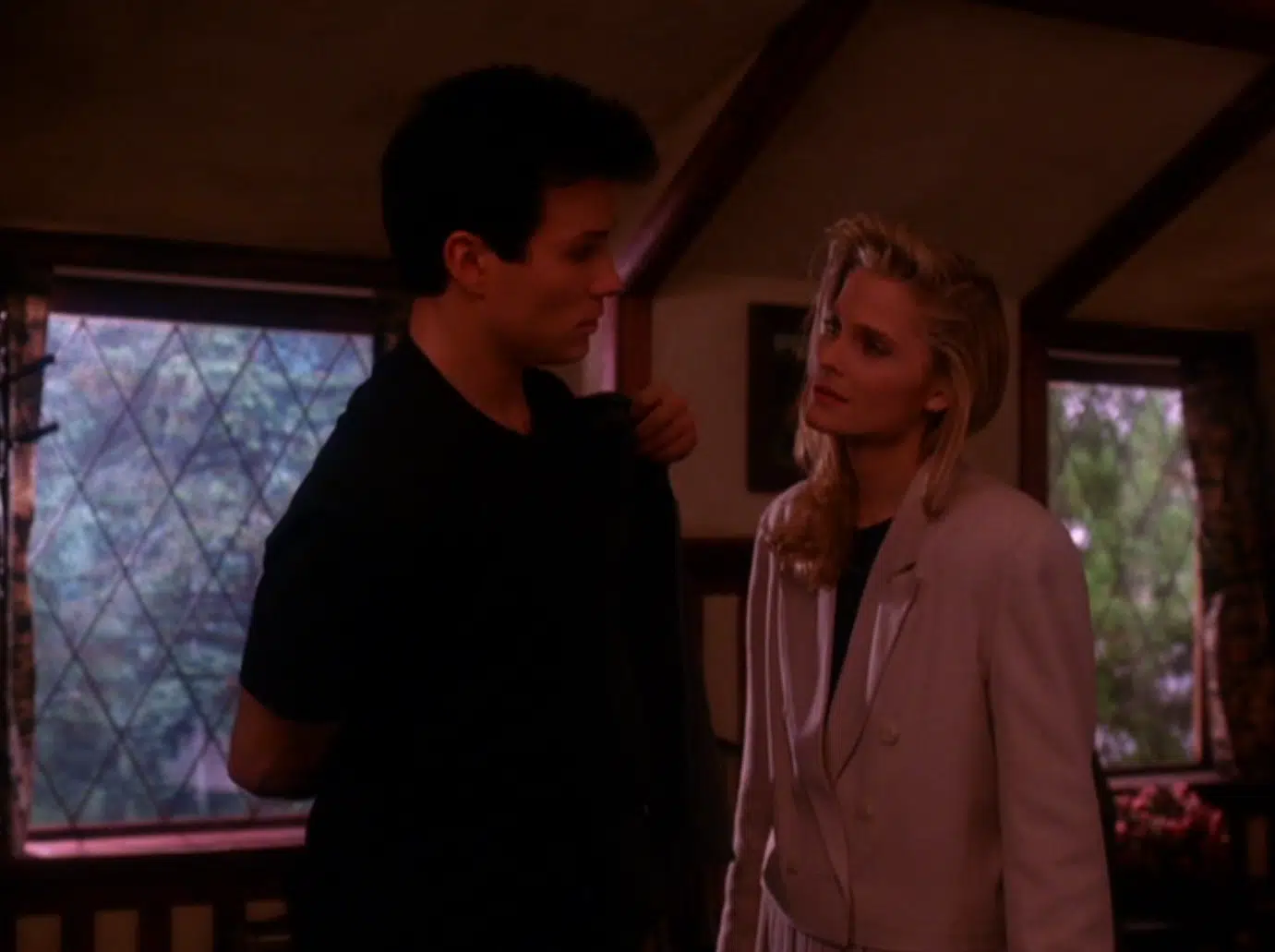
Watching this is surely a worse torture than anything Windom Earle can do
Having already destroyed one of Coop’s attempts at happiness prior to the events of the series, he became a credible threat, taking out numerous characters and even leading the call to Glastonbury Grove, the entrance to a plane of dark spirits only glimpsed in dreams before this point. Focusing on the climax of this was a key part of the finale’s success; even though Earle finds himself immediately out of his depth among literal demons, his character guided us back to the dark centre of the show, which was at its best, to quote Lynch, ‘wild at heart and weird on top’.
However, an underdiscussed element of this finale in light of its stomach-churning final act (and the Windom Earle madness leading up to it) is the destruction of the Twin Peaks bank, and some established characters along with it. While we later discovered that the fan favourite Audrey Horne survived, Jack Nance’s quirky fisherman Pete Martell, the man who famously reported his discovery of Laura’s body to the Twin Peaks Sheriff Department, does not, going out in an explosion alongside opportunistic wrong’un Andrew Packard.
As the ultimate conclusion to the controversial mill subplot, the most soap opera-esque element of the show, this moment is borderline nihilistic; the best of those involved was taken down with the worst, all over small-town greed. Though this part of the episode tends to be overshadowed by its later intensity, it sets an unsettling scene for the action to continue, promising us that no one is safe, and that the good won’t necessarily fare any better than the wicked.
Doppelgänger
The red room, the most iconic location of Twin Peaks even amongst non-viewers, is familiar, but it certainly brings no comfort when Coop steps beyond its curtains for the final time in the series. Confronted by humans once corporeal and spirits that have likely existed for time immemorial, his goal of rescuing his love interest Annie from Earle’s clutches may be clear, but his method of achieving this is anything but.
Thus begins the most bizarre sequence in the series up until this point, a scene where spatial continuity, the properties of physical objects, and even the consistency of individual characters is completely shattered. Coop is confronted by a series of people he knows (?) each morphing into others before his eyes, stating things they couldn’t possibly know or prove. Finally, after a relatively calm period of confusion, the spirit of Laura Palmer herself offers up her most iconic line – Meanwhile – and all hell literally breaks loose.
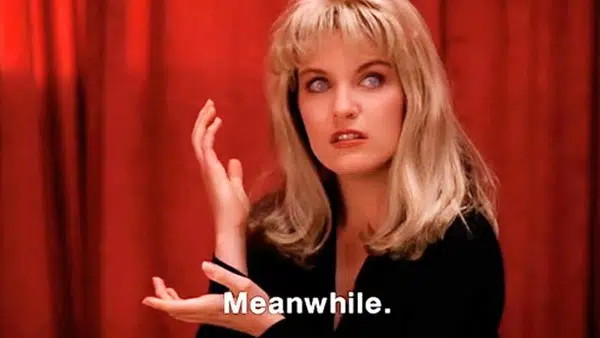
The Hand Gesture that Launched 1000 Tattoos
Lights strobe as Coop sprints through the curtains from place to place and the viewers themselves are assaulted by Laura, Cooper’s white eyed doppelganger, and eventually Killer BOB himself screaming and laughing maniacally into the camera lens. It’s a total assault on the senses that’s more purely cinematic than anything we’ve experienced up to this point – but it’s far from the most frightening moment of this nightmare ending.
Final Moments
The episode, and the original run of Twin Peaks, ends in a familiar spot: Cooper’s room at the Great Northern, home to many a shocking moment, but nonetheless something of a safe space, its warm wood panelling shining with the comfort of daylight. But immediately, something is wrong – a cold, unsmiling Cooper says he needs to brush his teeth, with Kyle MacLachlan giving his line delivery none of its usual charm or confidence. But it’s once he enters the bathroom, a common site of horror film bodily excess, that the consequences of his trip to the black lodge become apparent.
Carefully squeezing out an entire tube of toothpaste into the sink in an almost ritualistic fashion, we’re then placed looking out at Coop from inside the mirror, the twist being that this, somehow, is a point of view shot.
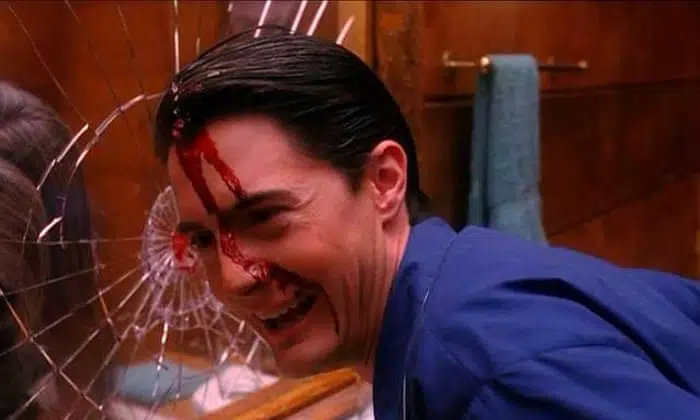
Maybe the finest moment of MacLachlan's career
Suddenly, he smashes his face against the glass of the mirror, a jarring act of self-harm accompanied by a disembodied scream that transforms into outright terror when we see BOB, the demon who has plagued the souls of Twin Peaks, staring back at him. The Cooper we know is gone, the game is over, and all we have left is the mocking, maniacal laughter of his Doppelgänger as he repeats the most threatening question put to television:
How’s Annie?
The credits appear for the last time across this scene, and audiences were left for 25 years with no semblance of an answer.
Losing Coop
Beyond the supernatural terror of our favourite FBI agent being possessed by a demon, and the many questions about the fate of the real Coop, the metaphor posed by the cynical Albert Rosenfield in an earlier episode lingers:
Maybe that’s all BOB is. The evil that men do.
This interpretation makes the ending of the show all the more upsetting. In a town full of male characters whose veneer of respectability barely covers their sins, Cooper has served throughout as one of a very small handful of straightforwardly decent men, acting out of selflessness and treating the women around them as human beings rather than vessels for their own vices.
In the shadow of Albert’s musing, the final question he poses – how’s Annie? – takes on a much bleaker meaning, implying that even Coop can’t avoid succumbing to the same cruel impulses that have already rotted Twin Peaks from the inside out, and that another innocent woman will be trapped in the web.
Did we ever Return?
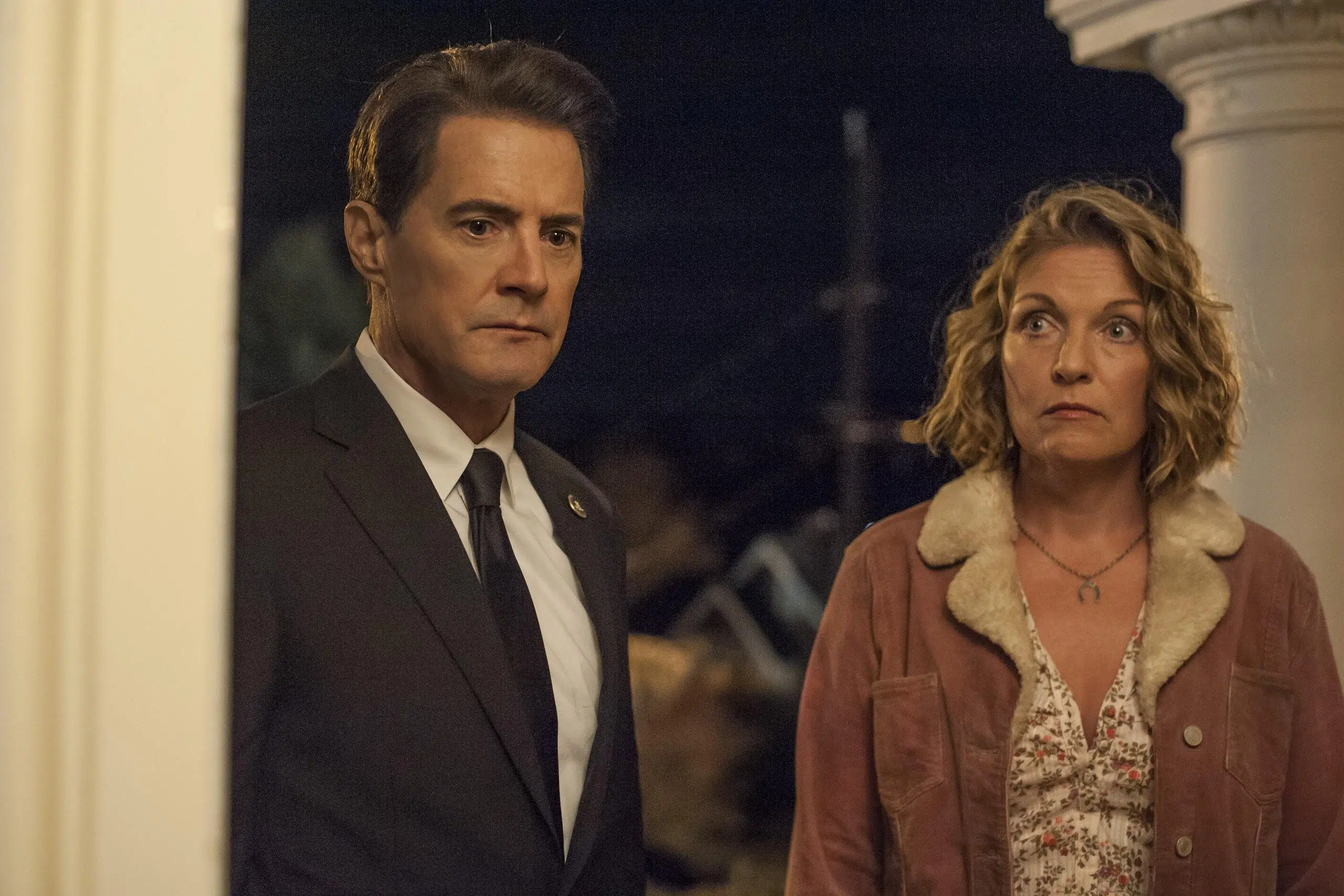
Cooper, I've a feeling we're not in the original series any more
When the project that would eventually be released as Twin Peaks: The Return was announced, a wave of relief began to build for long-time fans of the show, who had been waiting for closure since Cooper first smashed the mirror. If anything, this 18-part spectacle raised more questions than answers, and seemed like a deliberate commentary on the endless cycle of nostalgia heavy reboots keeping TV stale in recent years.
Its own finale is famously horrifying too, arguably bleaker than even season 2’s, but it’s hard not to feel even from Part 1 of The Return that the beloved 90s version wasn’t going to be coming back. Even if Coop could overcome the possession, what’s done is done, and the past at this point wasn’t just a foreign country; it was a town that never existed.
We may have seen some familiar faces, but Lynch knew it would never be the same – Twin Peaks ended with Coop’s corruption, and the devastation is no less easy to deal with in 2025.





Share your thoughts!
Be the first to start the conversation.