
In David Michôd’s Christy, Sydney Sweeney delivers the performance of her career as Christy Martin, a trailblazing boxer who rose from the rugged hills of West Virginia to become the face of women’s boxing in the 1990s. With every jab, bloody nose, and victory, the film chronicles not just the ascent of a female athlete in a male-dominated sport but also the harrowing emotional cost that accompanied it. This biographical sports drama is more than a boxing movie – it’s a bruising meditation on identity, trauma, love, and survival.
Set to an ‘80s soundtrack, the film opens in 1989 with Christy just 18 years old. She’s introduced to the audience in the ring, all geared up and wearing a Dr Pepper T-shirt. She's never boxed before, but walks away with $300 and the first taste of a new future. In her own words, voiced in narration, “Somebody told me once that I fought like I was trying to destroy everyone who had ever done me wrong.” “They said I fought like I had demons in me,” she continues. “Maybe it’s true. Maybe I do.” It's a line that sets the tone for the storm that follows: a story about fighting in sport, in life, and for one's very identity.
Sweeney is transformative here, as she morphs into a woman who must wear armour both inside and outside the ring (‘80s and ‘90s hairstyles included). Her Christy is tough, but never immune. Raised in a conservative household, her sexuality is treated as a threat to familial stability. Her mother, played with unnerving conviction by Merritt Wever, confronts her about a relationship with her high school girlfriend Rosie (Jess Gabor) and suggests she see a priest. It’s a brutal scene, not for its theatrics, but for its quiet cruelty. The film captures with eerie accuracy how homophobia is often cloaked in a desire to "help" or "protect." Her father (Ethan Embry) stands mute, mopey and ineffective, symbolic of the passive enablers of such repression.
After she catches the eye of Jim Martin (Ben Foster), a trainer who initially doubts “lady boxing,” her life takes a darker turn. Foster’s Jim is manipulative, venomous, and abusive. He orders sparring partners to go hard on her ("bust a rib if you have to"), micromanages her diet, and insists she grow her hair because "no one wants to watch a butch girl fight." It’s a microcosm of the misogyny women athletes face, not just from institutions, but from those closest to them.

Christy doesn't just have to prove herself in the ring; she has to sacrifice parts of herself to be allowed to exist in that space at all. She distances herself from Rosie and her queerness, opting for a more "acceptable" life by marrying Jim – not out of love, but as a means of survival. This inner conflict, her desire to be seen versus her need to hide, is mirrored in the way she fights: aggressive, relentless, and as if running from something unseen.
Christy's story is particularly resonant when placed in the broader context of women in sports. Historically, women have had to justify their participation in athletics in a way men never have. In the United States, Title IX of the Education Amendments Act of 1972 was a breakthrough, prohibiting sex-based discrimination in federally funded education programs, including sports. Yet, progress was uneven. Women were seen as novelties in arenas deemed "masculine," and sports like boxing, a domain of perceived brutality, remained near-impenetrable. Christy Martin smashed through that barrier. Martin was the first female boxer to sign with promoter Don King and regularly appeared on Pay-Per-View events. Yet, she was still asked more about being a wife than being a warrior.
The film nails this contradiction. As Christy's fame grows, the media fixates on her domestic life rather than her skill. It's a frustrating commentary on the double standards female athletes continue to endure. Even today, the U.S. Women’s National Soccer Team had to sue for equal pay, and tennis stars like Serena Williams have had to fight both literal and figurative battles just to be seen as legitimate.
The boxing scenes themselves, while not particularly innovative in their cinematography, are emotionally charged. Every jab is both literal and metaphorical. Christy punches not just to win, but to express everything she's forced to keep hidden. Yet the film also stumbles into familiar biopic territory, hitting the expected beats: training montages, rising stardom, tabloid pressure, and eventual downfall. It’s a story we’ve seen before, sure, but rarely have we seen it with a queer woman at the center.
What sets Christy apart is how it intertwines physical strength with emotional vulnerability. In one sequence, we see Christy shadowboxing in front of a mirror, arms constantly in motion even while brushing her teeth. She is never at rest, always preparing for the next attack, whether from an opponent, the press, her mother, or her husband.
Her nickname becomes “The Coal Miner’s Daughter,” a nod to her blue-collar roots and an ironic contrast to her growing fame. As she ascends to face boxing royalty, like Laila Ali in 2003, the stakes rise. For the first time, we see fear. Not just of losing, but of realizing that success built on suppression is unsustainable. Jim’s training, once essential, now feels like a shackle. She begins to understand that his influence was never about building her up, but about keeping her tethered to him.
The emotional gut-punch comes in the latter half of the film. As time passes, marked by quick title cards that fail to convey a real sense of the years, Christy's career wanes. She begins to lose fights and, more importantly, herself. Her once fiery persona is dulled by years of manipulation and violence. Her mother remains unsupportive. Her father remains useless. Rosie is long gone. Even her cockiness in the ring seems more like a mask than ever before.
In 2010, her story takes a shocking turn, one best left unspoiled for those unfamiliar with Martin’s real-life journey. What unfolds is a chilling reminder of how far the consequences of emotional and physical abuse can go, and how survival itself can become the final, hardest fight. It’s here that Christy elevates itself from just another sports biopic to something raw, necessary, and deeply human.
The film closes not with a triumph in the ring, but a quiet, devastating realization: the real win wasn’t a title belt or national fame, but reclaiming her life and identity from those who tried to control it. In a way, Christy is a reversal of the typical sports drama formula. Most end with a grand victory. This one ends with an escape.
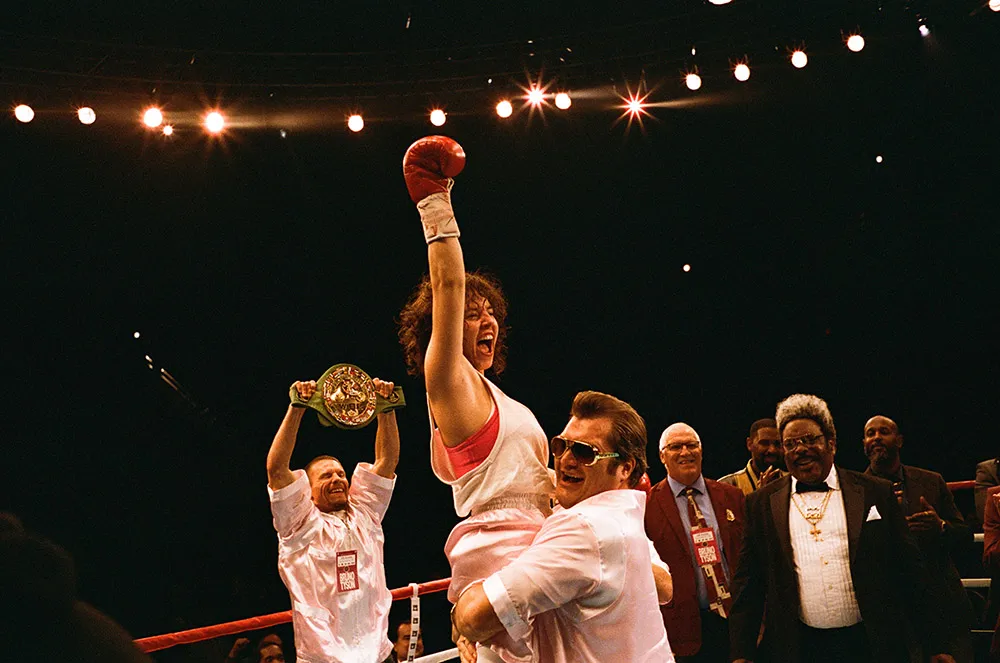
Christy isn’t a knockout. It sticks too closely to tired genre conventions, and its timeline feels rushed and uneven. But where it excels – in performance, emotion, and purpose – it truly lands a punch. Sydney Sweeney’s portrayal is as bruising as it is brave, capturing the paradox of a woman who had to become both a fighter and a prisoner to survive.
More importantly, the film reclaims a legacy. Christy Martin wasn’t just a boxer. She was a woman forced to fight for the right to be seen, heard, and loved. In telling her story, the film speaks to the experiences of countless women in sports who have been silenced, sidelined, and underestimated. In and out of the ring, Christy was fighting for more than victory: she was fighting for her identity, her freedom, and her life. This film ensures that struggle is not forgotten.






Share your thoughts!
Be the first to start the conversation.