
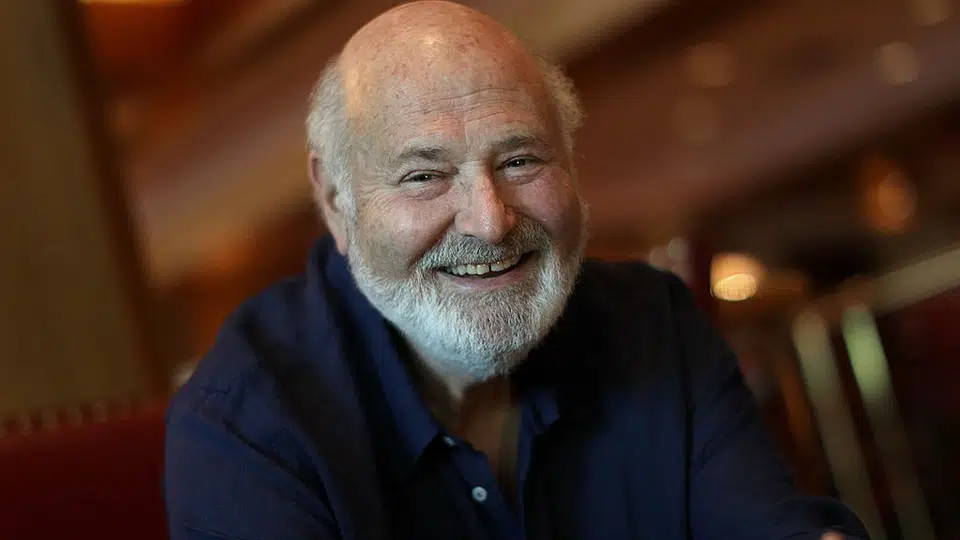
Remembering Rob Reiner feels like remembering several lifetimes at once. It feels like remembering laughter that echoed from living rooms in the 1970s, the quiet ache of adolescence captured on a railroad track in the 1980s, the electric rhythm of romantic banter that still shapes how we imagine love, and the steady conviction that stories matter because people matter. His passing is deeply tragic, the kind of loss that lands with a heavy pause, but the truth is that focusing only on the end would be a disservice to a life defined so completely by creation, generosity, curiosity, and influence. Rob Reiner’s legacy is vast, human, and enduring, and it deserves to be remembered in full color rather than shadow.
Reiner belonged to a rare category of artists who seem to understand instinctively how culture works. He did not just respond to the moment he lived in; he helped shape it. Born into comedy royalty as the son of Carl Reiner, he could easily have coasted on lineage alone, but instead he built something distinct and personal. His early fame as Michael “Meathead” Stivic on All in the Family made him a generational figure almost overnight. That character was more than a sitcom role. He was a mirror held up to America at a time of cultural fracture, a young idealist arguing across the dinner table with the old guard, sometimes self-righteous, sometimes naive, but always sincere. Reiner played him with warmth and frustration and just enough vulnerability to make him feel real. Millions recognized themselves or their families in those arguments, and comedy became a bridge rather than a shield.
It would have been easy for Reiner to remain comfortably in front of the camera, collecting applause and accolades, but his creative ambition pushed him elsewhere. When he stepped behind the camera, something remarkable happened. He revealed himself not only as a capable director but as one of the most versatile filmmakers of his era. What is striking about his body of work is not just its quality but its range. Few directors move so fluidly between genres without losing their voice. Even fewer manage to define those genres in the process.
This Is Spinal Tap was not just funny, it was transformative. It invented a new cinematic language while pretending not to try at all. The brilliance of the film lies in how seriously it takes its own absurdity. Reiner understood that satire works best when it is rooted in truth, and the truth of ego, insecurity, and artistic desperation is what makes that film timeless. It also revealed his gift for collaboration. He trusted performers, allowed space for improvisation, and created environments where humor could emerge organically rather than mechanically. That trust became a hallmark of his work.
Then he made Stand by Me, and with it, he proved that he could do far more than parody. The film is gentle without being sentimental, honest without being cruel. It understands childhood not as a mythic golden age but as a fragile, fleeting moment shaped by fear, loyalty, and loss. Reiner treated those young characters with respect, allowing their emotional lives to unfold without condescension. The result is a film that continues to resonate across generations, because growing up never stops being complicated.
If Stand by Me revealed his emotional intelligence, The Princess Bride revealed his generosity of spirit. That film feels like a gift handed down from one generation to another. It is playful, romantic, ironic, and deeply sincere all at once. Reiner understood that fantasy works best when it believes in itself just enough. He allowed the film to be silly and earnest simultaneously, trusting the audience to follow him there. Decades later, its lines are still quoted, its characters still beloved, its tone still unmatched. It is one of those rare films that seems immune to cynicism.
When Harry Met Sally is perhaps his most culturally influential work, not because it invented romantic comedy but because it refined it. Reiner understood that romance is often built on timing, conversation, and contradiction. The film’s dialogue crackles with intelligence, humor, and vulnerability. It treats relationships not as destiny but as negotiation, as something shaped by fear, desire, and history. The film also reveals Reiner’s willingness to put himself into his work, literally and emotionally. There is a sense that he was working through his own questions about love, friendship, and adulthood, and that honesty gave the film its lasting power.
He followed this with films that continued to defy expectations. Misery is tightly controlled, brutal, and terrifying in its intimacy. A Few Good Men crackles with moral tension and theatrical energy, proving that courtroom drama could feel cinematic without losing its intellectual bite. These films demonstrate Reiner’s deep respect for storytelling fundamentals. He believed in structure, performance, and clarity, not as constraints but as tools. His direction never called attention to itself unnecessarily. It served the story, always.
Beyond individual films, Reiner’s influence expanded through Castle Rock Entertainment, which became a home for ambitious storytelling across film and television. The company’s output helped shape the cultural landscape for years, supporting projects that valued character and narrative over spectacle. Even when his own directorial output slowed, his presence continued to be felt through the work he nurtured and championed.
Reiner was also a deeply engaged public figure. He did not treat art and politics as separate spheres. He believed that storytelling carries responsibility, that voices carry weight. His activism, whether focused on civil rights, early childhood development, or democratic engagement, reflected a belief that optimism is not passive. It must be practiced. He spoke with conviction, sometimes with bluntness, and always with the sense that silence was not an option. Even those who disagreed with him could not accuse him of indifference.
What made Reiner especially distinctive was that he never seemed embarrassed by sincerity. In an industry that often rewards irony over earnestness, he remained committed to humanism. He believed in people, in connection, in the idea that stories can make us kinder as well as wiser. That belief runs through his work like a quiet current. It is why his films age well. They do not depend on trend or shock. They depend on empathy.
His death is painful precisely because it feels like the loss of a voice that still mattered. It feels abrupt, unfinished, unfair. There is a sense that he was still thinking, still engaging, still arguing, still laughing. But there is also comfort in the fact that his work remains not as relics but as living texts. They are still watched, still debated, still loved. They continue to shape filmmakers, writers, and audiences who may not even realize how deeply they have been influenced.
Remembering Rob Reiner means remembering someone who understood that comedy and seriousness are not opposites. They are partners. It means remembering a filmmaker who trusted audiences to feel deeply and think clearly. It means remembering a man who believed that art could entertain without numbing and persuade without preaching. His life was full of contradictions and passions, and his work reflects that richness.
In the end, while the tragedy of his passing cannot be ignored, it does not define him. What defines Rob Reiner is the way he made people feel seen, whether through laughter, recognition, or quiet reflection. He gave us stories that stayed with us, characters that felt like companions, and moments that became part of our shared language. That kind of legacy does not fade. It settles in, becomes part of us, and continues to speak long after the voice itself is gone.





Share your thoughts!
Be the first to start the conversation.