
Last Friday, May 22nd, I had the opportunity to attend the preview screening of the film "Backrooms," directed by 20-year-old Kane Parsons, who made his feature film debut with this film. Based on his popular YouTube series "That's a Bad Idea," it was produced by Chernin Entertainment and distributed by A24 with a budget of $10 million. The film expresses, and seeks to bring to the big screen, the renewed psychological horror that emerged from the digital village of 4chan in 2019, stemming from a photograph taken in 2003 at a toy store called Huby Town in Wisconsin, USA, during a renovation. This gave rise to theories and speculations fueled by the collective fascination surrounding a question that exists on two levels: the psychological and the real. On the real level, the question is "What?" Fueled by successful short films, the psychological aspect was overshadowed by the mass sensationalism of a story that lost its impact with the addition of narrative elements that deviated from its spiritual principle: being a mirror of our loneliness.


With a budget of 10 million dollars, “Backrooms” manages to revitalize the horror genre, starting from a faithful representation of the history of our time, its audience, and the social environment with which they interact. While classic horror speculated on people's fears, defined by isolated stories and interpreted by writers, current horror is built in community, with the collective contribution of all those interested around a hypothetical premise presented anonymously. This transforms a story into a viral phenomenon of collective credibility, given the absence of any authorship. Which brings us to its medium of dissemination: chat rooms.
These platforms proved last year to be the primary source of communication and interaction for Generation Z, allowing them to express their discontent with government policies, coordinating and calling for action. The protests against them, in some cases ending with their overthrow, as happened with the government of Nepal, are a continuation of this generational disruption. "Backrooms" is a film born from these same media outlets, raising questions about the future of culture and the role of authorship: will filmmakers retain power over their work, or will they become mere interpreters of public demands? It's not the first time the public has sabotaged or intervened in the content of films, as these are based on pre-existing works already established with a fan community. But when this community is also the creator and disseminator of the work itself, art begins to become a psychological reflection of a pattern, which, ironically, the film faithfully reflects.
The Backrooms are a dimension of hallways and rooms with a monotonous yellow color and the whirring of fluorescent lights that illuminate without any pattern of shadows. These spaces are notable for their lack of windows and spatial references. Something that indicates our location, coupled with the appearance of real-world objects that seem distorted in their forms. This reminds us of the same dreamlike distortions of our subconscious, and how, in the recollection or reconstruction of events, these are never faithful to reality. The collective construction of art falls into this same trap, where the fascination with the unknown becomes an excuse for denial and self-deception regarding our own pathologies that we cannot conceptually define.


This leads us to question the very purpose of art, whether it is an experience or a revelation for its viewers. The market always seeks to exploit an emotion, which then exhausts itself in its own psychological reaction, without reaching a revelatory conclusion that awakens the viewer's consciousness. An emotionally mature viewer becomes immune to the sensationalism of the expectations that fuel these stories—stories that, in our feigned rationality, we deem false, but upon observing our reality, we see how they are considered true economic narratives of individual success or market freedom. It is this same credulous and childlike public that is culturally denied moral lessons that would allow them to confront their own inner demons.
History reflects this with the interpretation of the labyrinth and the Minotaur, the backroom being a reflection of our psyche absorbed by the monotony of modernity, trapping our lives in an endless cycle of guilt and frustration. Here we find it with the “monster” of our protagonist, Clark, who reflects workplace alienation in his psychic projection of himself, disguised as a pirate and devoted to his work. And, although Clark tries to dialogue with it, he is devoured in a clear reference to Francisco Goya's painting “Saturn Devouring His Son.” However, the aesthetic experience does not transcend into a resolution, except for the point made by therapist Dr. Mary Kline to Clark about his own responsibility for everything that happens to him, insisting that he abandon his victimhood.
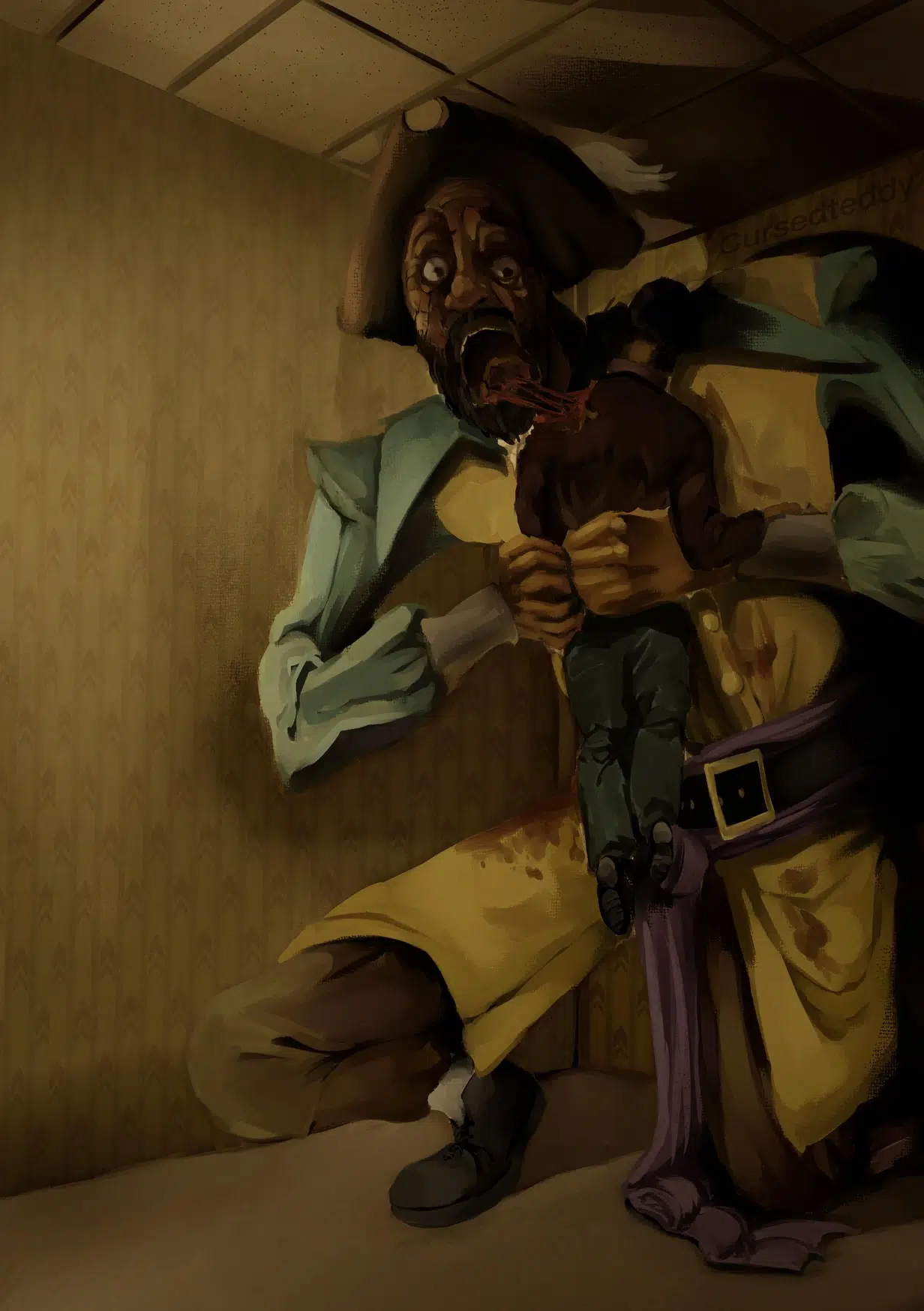
The problem with the narrative is the protagonist's lack of redemption. He gains a faint self-awareness, freeing his therapist from his constraints, but then immediately, upon lowering his guard, he is attacked by his own monster, without sacrifice or confrontation. This conceptual “inertia” extends and justifies the original premise that the story sought to question, showing us the character's consequent weakness after his awakening. Thus, the "backroom" ultimately triumphs in its reflection of our own alienation.
Therefore, "reality" absorbs us into its fiction, without ever fully questioning reality itself, and we are slowly absorbed, as subtly indicated by the misplaced light switches in the store, by the alienating mirror of our subconscious. The cinematic cultural outcome of a democratization of fascination over reflection is both troubling and consequential, demonstrating that industrial performers are useless if their works lack a transcendence that leads us to that healthy rebellion against the imposed order. And precisely because the imposed order springs from our own desires, their frustration, and the cyclical return in their pursuit, the only solution offered is escape through the window proposed by the protagonists—a window nonexistent in the backroom, but present in our minds, the window of redeeming epiphany.






Share your thoughts!
Be the first to start the conversation.