
Ponyo is a 2008 Studio Ghibli movie, written and directed by Hayao Miyazaki. On a budget of $34-million (U.S.), the film grossed $205.9-million (U.S.) at the box office, becoming one of the highest-grossing animes in history.
The other night was my first time ever watching this movie. What stood out the most was the complexity of its main characters.
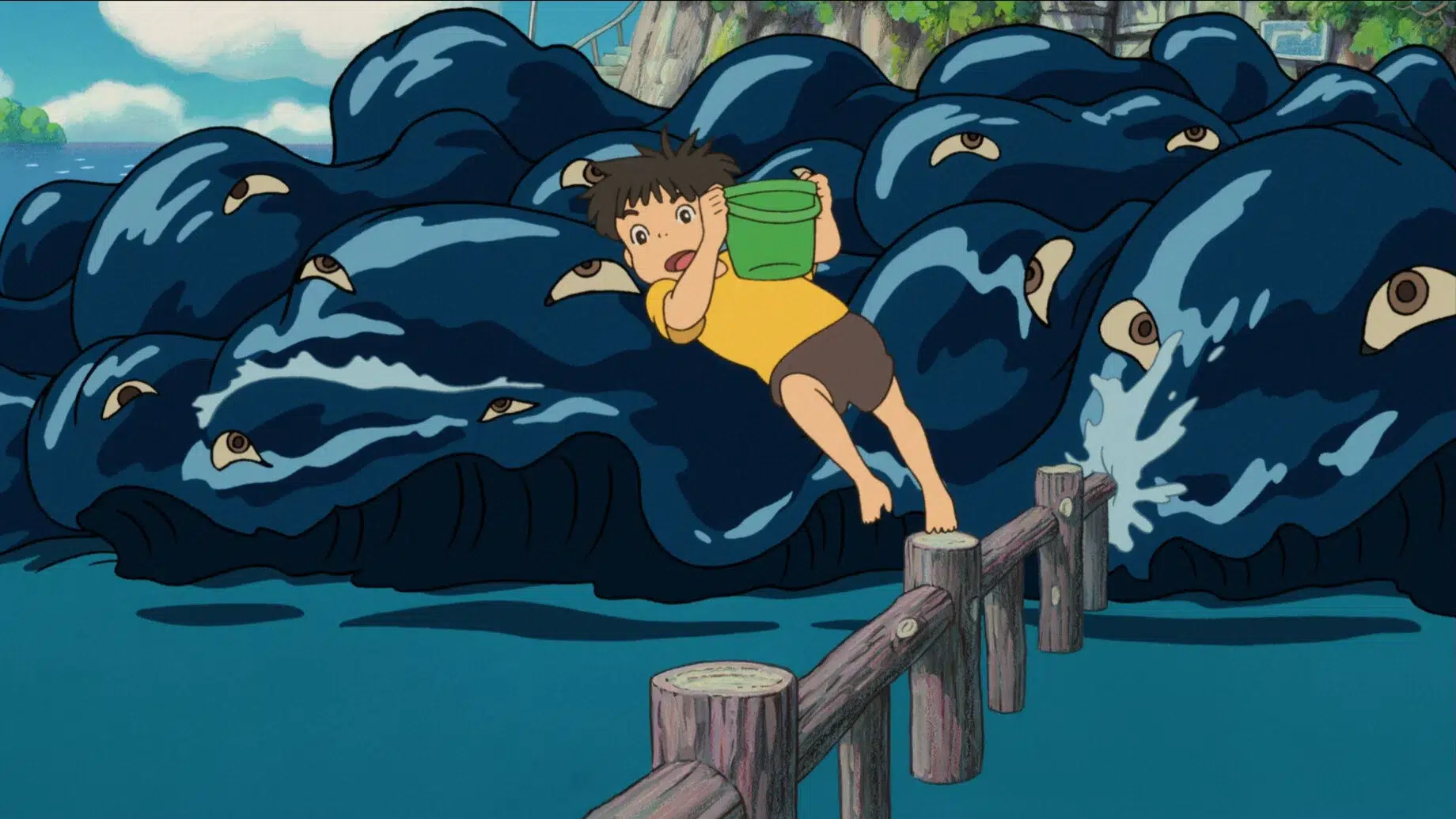
Sōsuke
Sōsuke is the boy whose eyes a majority of this movie is told through. While other children's' animations will leave it dubious whether what the child is seeing is imagination or not, Miyazaki makes it clear that what Sōsuke is seeing is real. This heightens the magical realism of the film and ups the consequences of Sōsuke's actions.
I liked that Miyazaki doesn't let Sōsuke off the hook easily. Lots of his actions are led by his childlike ignorance. When he first takes Ponyo from the water, he doesn't realize that the water is trying to pull Ponyo back. Later, he won't heed the old woman's warning that Ponyo will bring bad luck and a tsunami.
Although technically a kid's movie, I liked that the consequences were always real for Sōsuke and the others in this world. It helped create the tension that kept me hooked from start to finish.

Ponyo
As the consequences are always nearby for Sōsuke, so too are they for Ponyo. A magical, goldfish-like creature that will later turn into a little girl, Ponyo holds great power, but she is too young to realize how much effect she can have on the world.
Ponyo's intentions are in the right place. She only wishes to be reunited with Sōsuke after they were unceremoniously separated. However, her unworldly power over the ocean brings great destruction to Sōsuke's town. Although we're cheering for Ponyo and Sōsuke's reunion, I couldn't help but watch with tension in my chest. I didn't want this wonderful seaside town to fall to ruin just so these kids could be back together.
It's this mastery of tension veiled behind childlike wonder and desire that makes Ponyo such a captivating watch. Of course, Ponyo is very adorable and I want her to have everything that she desires, but the real-word consequences kept me worried that she would cause more harm than good.

Lisa
Lisa is my queen. She's the mother of Sōsuke and our tether to reality. It's because of Lisa that we know that what is happening with Sōsuke and Ponyo is real and not part of the young boy's imagination. She earns my praise for how calmly she handles the situation.
That's not to say that Lisa is an always-smiling, static character. Lisa has depth. Her very first scene shows her frustrated with Sōsuke as she runs late for work. It's her tardiness that keeps Ponyo away from her father, and sets off the adventure that will unfold.
Additionally, she faces love trouble just like anyone else. She has a fantastic scene where her husband, a sea captain, can't make it to shore in time for a promised dinner. It leads to a very relatable and comical scene where she uses the light from her bedroom to call him an idiot through light signals.
Her final meeting with the Gran Mamare is puzzling, largely because we are never told what they talk about. It seems like the talk helps Lisa with some sort of trouble, or it's a chance for Gran Mamare to better understand the home that Ponyo will be going to if she turns human. As with this entire movie, this scene is visually stunning, and I liked that they kept the conversation obscured. What I can imagine is most likely greater than what was actually said.

Fujimoto
Fujimoto is my favourite character in Ponyo. I love how his character develops. No backstory is given, but we can deduce that he was once a human that got sick of humanity and turned to live in the ocean. He's obviously some sort of mad genius/magician.
At first, we believe that Fujimoto is evil. He keeps Ponyo in captivity with her many siblings. He seems controlling and not understanding of Ponyo's wishes. However, as the movie continues, we start to see Fujimoto in a different light.
From Ponyo's perspective, Fujimoto is evil, but it's revealled that Fujimoto serves as a metaphor for all fathers who have to cope with seeing their children grow up and leave the safety of the home.
To me, Fujimoto becomes the ultimate sympathetic character. His methods are imperfect, as is usual for most of us, but his intention is from the heart. He simply does not want to lose Ponyo, or Brunhilde as he named her, one of his most magical creatures. The lesson for him to learn is one of letting go.
I sympathized very much with Fujimoto. From his reclusive decisions, to his fear of Ponyo's mother, to his desire to keep his children close to him even after the child has made their own, autonomous decision, I found Fujimoto to be very human despite his magical capabilities.
Plus, I just loved his look.

Gran Mamare
The final character I want to talk about is Gran Mamare. She stays largely an enigma in Ponyo, until the end where she plays a pivotal role.
To me, she is an aquatic version of Mother Earth — an all-controlling, ultrapowerful being that is beautiful but dangerous.
The visuals in the Gran Mamare scenes are the best in the film. They are hallucinatory and unique. It's through these visual feasts that Ghibli has earned its reputation for stunning animation worthy of a place in the best art galleries.
From a plot perspective, I didn't like that Gran Mamare was used kind of like a deus ex machina to wrap up the story. When Ponyo and Sōsuke are reunited, Gran Mamare just declares that things can return back to normal. Despite the ravaging of the town by the sea and Fujimoto's celestial concerns about a growing moon, it just takes a few words from Gran Mamare to restore order to the world. While it wrapped things up nicely and proved the power of Gran Mamare, it also felt like it let Miyazaki off easy. He created a mess but didn't have to clean it up.

Nonetheless, Ponyo is a simply magnificent movie. It can be labelled a kids movie, but there's much more to this than a simple story. The characters are all dynamic. There are themes of environmentalism, responsibility and control. Despite having a five-year-old protagonist, I found this movie to be profound in its messaging of human behaviour. I loved to see the young Ponyo not get off the hook for her selfish actions. I was fascinated by the development of Fujimoto. And the heart of the film, Lisa, kept me tied to the reality of it all.
It's expertly crafted. I'd say, it is a must-watch for anyone looking for a magical film with stunning visuals and an engrossing story.


Share your thoughts!
Be the first to start the conversation.