
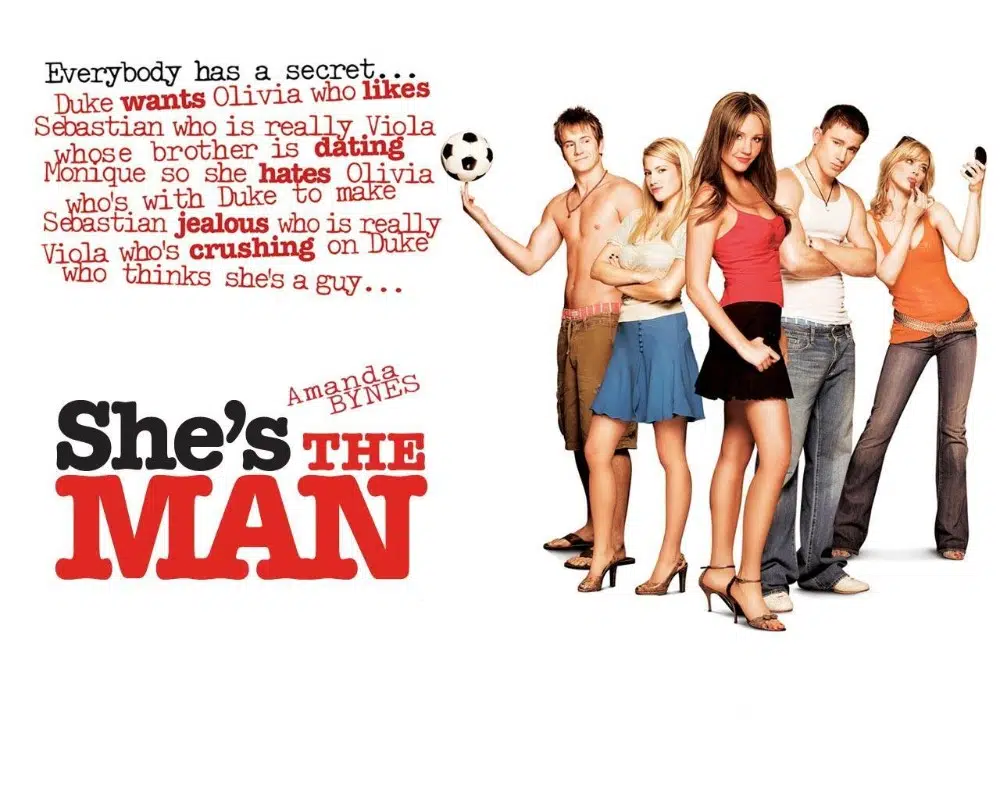
Hey there, welcome to our Popcorn Review of "She's the Man," a commercial, romantic comedy directed by Andy Fickman and starring Amanda Bynes. In this review, I'll tell you what I thought of the film, whether I liked it or not, and whether I think you might be into it too. I'll also discuss how the movie explores gender identity and self-awareness among teenagers.
I wouldn't say this is the most awkward film I've watched, it is certainly not a masterpiece. The middle part of the film does offer some excitement and entertainment, but it is not enough to save the overall mediocrity of the film. In fact, I believe if it were not for the middle section, the film would be a prime candidate for the infamous Golden Raspberry Award. Both the beginning and the ending are disappointingly lackluster, failing to deliver on the promise of the middle section. Perhaps some additional character development or plot twists could have been added to make the film more engaging and memorable.
She's the Man is this romantic comedy flick that Andy Fickman directed and starred Amanda Bynes in. It came out in 2006 and got mixed reviews - some critics thought it was a hoot with funny moments and great acting, but others just didn't like how predictable the plot was.
But check it out - the movie was marketed as "based on William Shakespeare's Twelfth Night" in the advertising campaign. Fickman even said in some interview that it was a tribute to the play. In the movie, Amanda Bynes plays Viola, who pretends to be her twin brother Sebastian so she can play on the boys' soccer team. The story follows Viola as she tries to keep her real identity on the down low while still dealing with all the awkward high school romance stuff.
I have to say, while adaptations like this can bring more attention to the study of Shakespeare, it's worth noting that the film sets a poor example for teenagers in terms of gender identity and self-awareness. As Colby College Shakespeare professor Osborne argues, "The Shakespeare play, however loosely adapted, can illuminate the ideological work and shortcomings of the teen film, and, more radically, the teen film can comparably illuminate the Shakespearean play."
The protagonist, Viola, undergoes an internal transformation throughout the film that ultimately ends in disappointment. Although she embodies a strong "Girl Power" vibe, she abandons it in favor of her feminine identity in the name of love. While her act of switching identities is not an issue, the fact that she feels compelled to do so because of her love interest's desire for her to remain a girl is concerning. The scene would have been more impactful if Viola's desired identity had been accepted.
Duke's line was problematic because it implied that if Viola chose to go against his wishes, it would cause trouble in their relationship, forcing her to choose between him and her authentic self. Was Viola given a chance to decline? After everything they had been through, they were expected to be together at any cost, which essentially robbed Viola of her free will. It was disheartening that after all of her hard work and struggles to disguise as a boy to prove she’s better than boy, ultimately went for nothing. This message is problematic.
The film raises interesting questions about the role of gender and the pressure to conform to societal expectations. One particular scene where Viola is forced to reveal her body to prove her gender is particularly troubling. Although the director does not appear to be using nudity for exploitative purposes, the fact that Viola is pushed to such an extreme suggests that this might be the only way out for individuals in similar situations. This is a disheartening message to convey to audiences, especially young people who may be struggling to find their place in the world.
Furthermore, the film's marketing as a Shakespeare adaptation is disingenuous at best and insulting at worst. While the film certainly draws inspiration from Shakespeare's work, it takes significant liberties with the source material and can hardly be considered a faithful adaptation. By marketing the film as such, the producers may have misled viewers who were expecting a more conservative interpretation of the play. After all it is not a parody, isn’t it? Despite these criticisms, it is worth noting that the film is not without its merits. The performances are generally strong, and the editing is smooth. Additionally, the film's exploration of gender roles and societal expectations is an important and timely topic that deserves further exploration.
Nevertheless, I was impressed by the adaptation of Twelfth Night which infused a Girl Power concept and a soccer dream background. While the film had some room for improvement, it was still brilliant in certain aspects. The soccer field is a place where teamwork is not only important, but vital. The film's depiction of this was particularly poignant, highlighting the need for perseverance and determination in order to succeed on and off the field.
When Viola disguises as a male soccer player on the field, she faces two enormous challenges simultaneously: 1. Maintaining the male figure, and 2. Winning the game. The tricky part is that by sustaining the male figure, she cannot concentrate on the game, and by focusing on the game, she cannot maintain the male figure. In larger sense, she is under the spectatorship of both her teammate and the audience of the soccer field. As she approaches winning the game with a male figure, she becomes further away from her original identity. Throughout the game, we see this tug-of-war, which leaves Viola feeling lonely and helpless because she cannot reveal her true identity.
So, yeah, She's the Man is a fun and chill movie that gives Twelfth Night a modern spin. I enjoyed this film because it had some humorous moments that made me laugh out loud. However, there were also parts of the film that were not very good and detracted from my overall enjoyment. Despite this, I would still recommend that you watch the film because it is unique. I hope to see more films with similar themes in the future, but with better execution.
[1] Osborne, Laurie E. “‘Twelfth Night’s’ Cinematic Adolescents: One Play, One Plot, One Setting, and Three Teen Films.” Shakespeare Bulletin 26, no. 2 (2008): 9–36. http://www.jstor.org/stable/26347689.




Share your thoughts!
Be the first to start the conversation.