
It's a challenge to assert that Kingdom of the Planet of the Apes qualifies as a masterpiece, especially with its ultimately cliché and outdated return to human-centered themes. Nevertheless, the magnetic appeal of the animal characters within it cannot be denied. Whether it be the protagonist chimpanzee Noa (Owen Teague), the antagonistic gorilla Proximus Caesar (Kevin Durand), or the briefly glimpsed orangutan Raka (Peter Macon), these characters are rendered with such vividness that one can almost feel the texture of their fur, sense the warmth of their embrace, the chill of their wetness, and the sting of their blood.

In movies where animals take center stage, the dynamic between animals and humans is perpetually worthy of contemplation. Films like Hachi: A Dog's Tale, Lassie, and War Horse offer glimpses into the humanity of animals (indeed, animals often exhibit more "humanity" than humans themselves in most animal-centric films), and their profound spiritual connection with humans. However, ape protagonists hold a unique place among them. As primates, they bear a striking resemblance to humans, possess greater intelligence, and engage in more nuanced physical and emotional interactions, thus fostering more intricate emotional bonds with human protagonists.
In Rise of the Planet of the Apes, the relationship between Will Rodman (James Franco) and Caesar (Andy Serkis) evolves from master-pet to friendship, and eventually to two autonomous individuals. In King Kong, the romantic relationship between Kong (Andy Serkis) and Ann Darrow (Naomi Watts) blossoms. And in Godzilla vs. Kong, Kong and humans elect to fight alongside each other.

1933 marked the introduction of cinema's first ape protagonist, Kong, who has since become one of Hollywood's and the world's most iconic monsters, spawning a multitude of works. From initially facing criticism for its perceived racial undertones in King Kong to Peter Jackson's seminal remake, and now the fourth installment of the Planet of the Apes series, ape protagonists consistently validate their cinematic allure through robust box office performances. Despite their intimidating exteriors, ape protagonists are, in fact, more captivating than their human counterparts, even when compared to the likes of Adrien Brody's character.
But how? They don't have the handsome looks of Leonardo DiCaprio or the wealth of Mr. Darcy. They do not employ sweet rhetoric. Yet, do you recall the denouement of "King Kong," where the gorilla, amidst a relentless pursuit by land, sea, and air forces, still takes the female lead to the summit of the Empire State Building to witness the sunrise? Contrary to the character Carl's (Jack Black) assertion in the film, it was not beauty that slew the beast, but rather, romance. Kong epitomizes romance in its purest form, leaving men across the globe envious. The scene where Kong and Ann sit together atop the skyscraper should be enshrined in cinematic history, akin to the iconic moment in Titanic where Jack leads Rose to the bow of the ship, both standing with arms outstretched, basking in the wind.
He possesses nothing, yet he provides the female lead with the most unforgettable zenith of her existence.
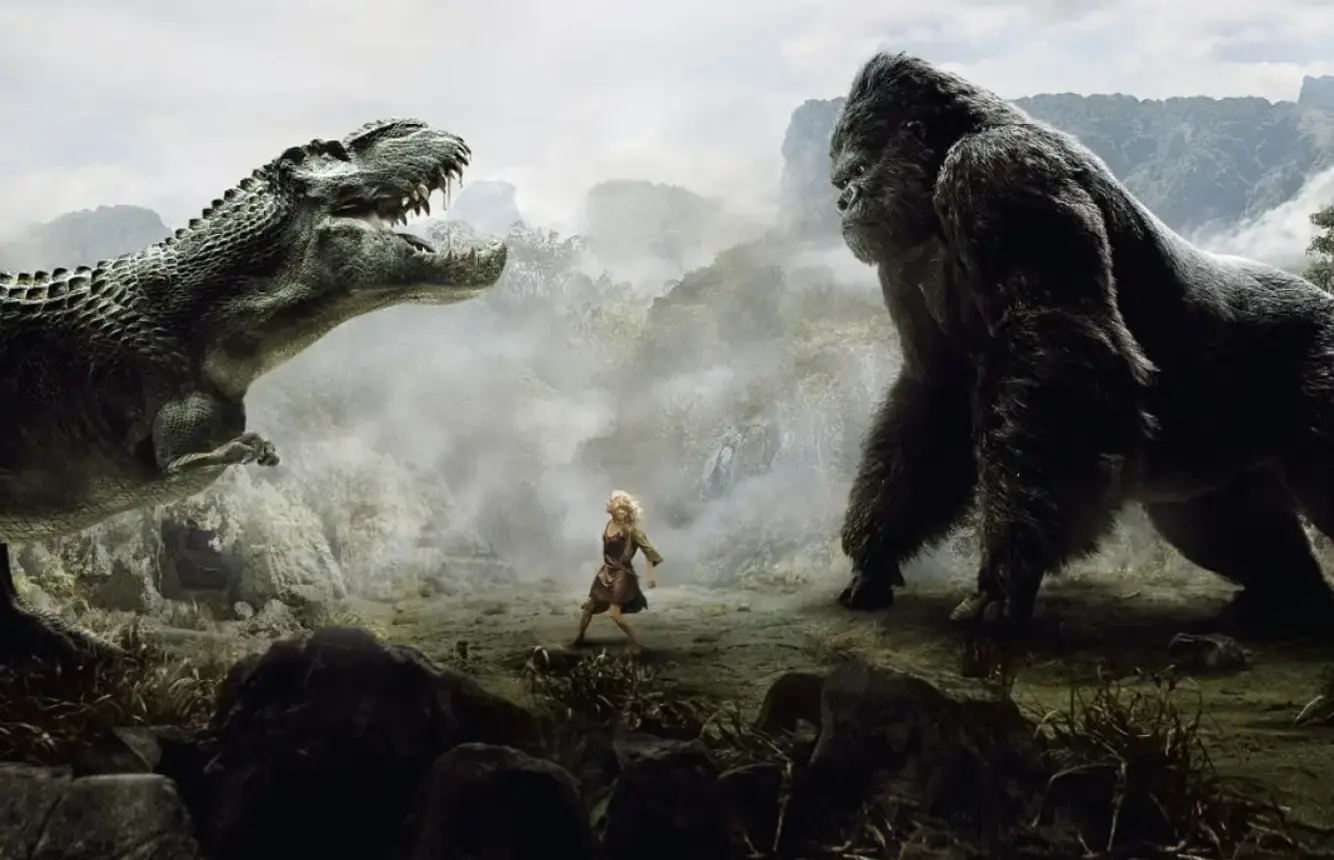
In reality, it is the extreme qualities and stark contrast between their physical attributes and personality traits that underpin their charm. They appear rugged, massive, strong, commanding, and have deep, booming voices, all typically representing the epitome of masculinity. Yet, concurrently, they harbor complex personalities; they are inquisitive, protective, empathetic, yet tragically misunderstood loners. The Kong initially revered as a deity on Skull Island had his fate altered by an external group armed with technology and weaponry. He was deemed a lucrative venture by greedy businessmen, hunted down, transported to America akin to a slave from a bygone era, incarcerated, exhibited as a spectacle, exploited, and ridiculed.
In essence, Kong embodies a sort of fallen hero archetype. He is undeniably formidable, yet exhibits absolute tenderness towards his beloved female lead. He exudes an aura of exotic allure, nobility, and dignity. His silence conveys stoicism and enables him to sacrifice everything for his beloved female lead without seeking acknowledgment.
In the primitive jungle, he valiantly safeguards the female lead; in the modern society of steel and concrete, he manifests unwavering resolve to resist human oppression. He can be interpreted as an allegory for nature's resilience in the face of human arrogance and avarice. His struggle against human power, whether it's capture, exploitation, or confrontation with modern civilization, carries deeper metaphorical meanings.
In Peter Jackson's rendition, Kong and Ann's relationship develops incrementally. Following Kong's vanquishing of three tyrannosaurus rexes and enactment of the archetypal "hero rescues the beauty" scenario, Ann climbs onto his shoulder. When they return to Kong's "home," their relationship undergoes a qualitative change. Ann sits on Kong's hand voluntarily, having been taken away from human society by him, her previously bound hands now her solace. Kong turns his head calmly, and they both admire the sunset from the peak of Skull Island.
This gorilla has the tender gaze of a first love. Initially curious about Ann, not understanding how to interact with her, he later becomes deliberately sulky with her, gently holds her in his hand, and protects her at all costs. When he knows he's about to lose her, tears well up in his eyes, and he bids her farewell, facing death alone.
The love story between Ann and Kong thus unfolds. Between Ann and Kong, Ann initially rebuffs, then embraces, and ultimately actively pursues a monster. Their relationship mirrors the timeless essence of the Beauty and The Beast narrative: Belle, the merchant's daughter, replaces her father in the beast's castle, enjoying lavish hospitality, and the beast proposes marriage to her daily. Though she never assents, she discerns the beast's kindness and begins to harbor affection for him. However, compared to Kong's heroic rescue of the beauty, when Belle returns home to visit her father, the beast is heartbroken and on the verge of death, saved by Belle's kiss.

Stories like Beauty and The Beast narrate not merely love stories, but narratives of transcending initial apprehensions and ignorance to discover genuine love. Both parties involved in the romance, from the initially proactive one possessing all knowledge and power to the initially passive one characterized by ignorance and curiosity, ultimately come to understand each other's true essence and treat each other as equals.
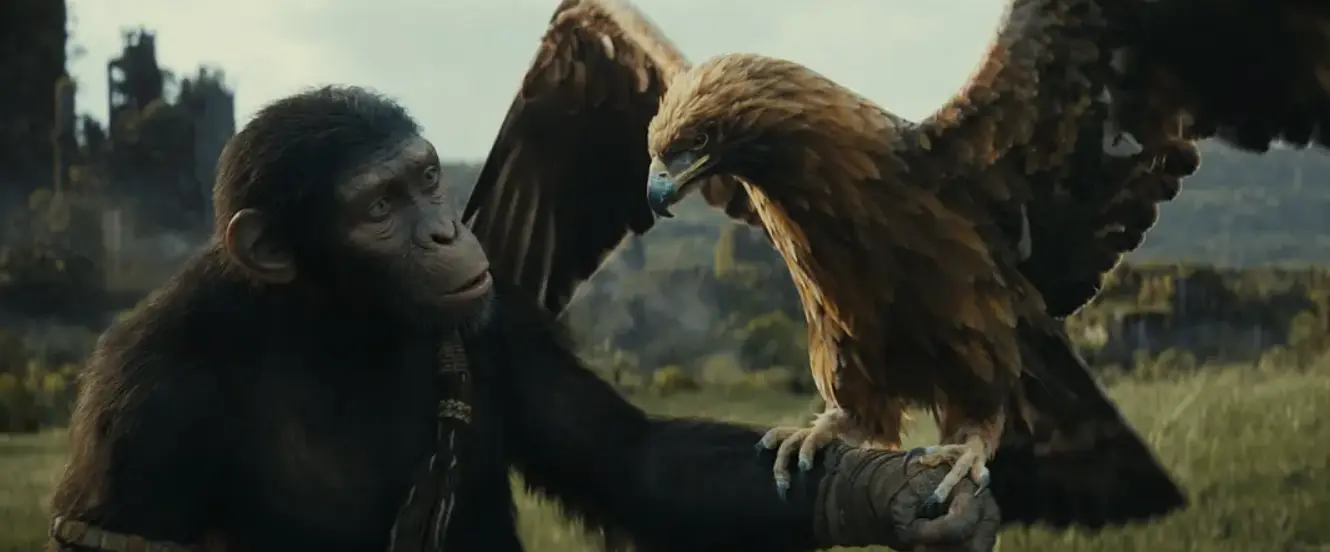
Today, the relationship between human female leads and ape male leads offers fertile ground for further interpretation. In Kingdom of the Planet of the Apes, Noa's sanctuary is ravaged, his kin and tribe are abducted, and he embarks on a solitary journey of vengeance. Meanwhile, Nova/Mae (Freya Allan), for various reasons, becomes estranged from her human compatriots, navigating the perilous jungle in search of survival. Yet, unlike preceding Beauty and The Beast narratives, Nova is not the fair-haired, blue-eyed epitome of beauty, and Noa is not the formidable Kong. He carries her on his back, scales cliffs with her, while she possesses knowledge and culture. The film wisely refrains from defining their relationship, allowing sparks between them to be interpreted as friendship, siblinghood, or romantic involvement, all the while maintaining an adversarial yet amicable dynamic.

Regardless, the moment when Noa hears the cry of the Nova/Mae from afar, gallops toward her on horseback, and ultimately rescues her from the clutches of the main antagonist, must surely be one of the most stirring moments in the entire film.
Ape protagonists have transcended being merely movie characters and have risen to become cultural symbols, witnessing the evolution of social trends such as racism and feminism over their 91-year history, as well as advancements in biological science and computer-generated effects. As the New York Times critic Andre Sennwald put it, "Hollywood has always been able to quickly reflect or stimulate popular tastes; that's what they've always done."






Share your thoughts!
Be the first to start the conversation.