
On a technical level, there are certainly many aspects of this film that are worth a close examination. The staging, editing, performances, and script are all excellent. However, I would prefer to discuss it from another perspective.
1) The Era in Which Myths Are Told
In the study of ideological cinema, there's a saying: it’s not about the era the film depicts, but the era in which the film was made. For example, when comparing films about the Chinese Civil War from the 1950s and 60s to "The Founding of a Republic," the different audiovisual styles, narratives, and market strategies will undoubtedly reflect subtle nuances of the era in which they were made.
Even for an ordinary audience, the pleasure of watching a 1940s Hollywood gangster film can be significantly diminished.
Without a doubt, "The Terror Live" has something particularly special. What interests me is, what exactly aligns this film with the pulse of our times?

2) The Patchwork of Postmodernism
I can't definitively say that we have entered the postmodern era, but without a doubt, many postmodern characteristics are very evident in film production.
When discussing postmodernism, certain features come to mind: fusion, pastiche, flattening, de-centering, and anti-authoritarianism. Unlike modernism's pursuit of depth and philosophical thought, postmodernism leans towards ambiguity, multiple meanings, and a lack of depth. In fact, the trend of genre blending in Hollywood films is seen as a postmodern characteristic. Their genre-blending has developed over decades and is no longer novel.
For a nearby example: "Hotel Transylvania." While its format is an animated film, at its core, it’s a conventional coming-of-age story, mixing elements of horror, comedy, and musical. Besides this blending, it also subverts traditional horror films in a way, using classic horror characters while still being a sort of anti-horror film.

3) What Does "The Terror Live" Blend?
Some say "The Terror Live" is a typical genre film. In fact, it is not just a "typical" genre film; it is an anti-genre genre film.
What genre is this film? A disaster film about a terrorist attack. However, the director completely bypasses the most crucial scenes of disaster and rescue, presenting these aspects from a side perspective. This makes it a disaster film without a disaster.
Medium is meaning. The choice of medium for expression by an artist significantly impacts the final outcome. Kim Byung-woo uses the disaster film framework to create an anti-disaster, subversive disaster film. From this perspective, the disaster film as a medium is inherently meaningful.
But if we say that "The Terror Live" merely stays at the level of Hollywood-style genre-blending and subversion, we would be underestimating Kim Byung-woo's ambition.
What surprises me most about this film is that it doesn’t play with genre; it plays with media.
The closest sibling media to the film are theater and television. Theater is the elder brother, television the younger. Each has its similarities and differences with film. "The Terror Live" as a film incorporates both theater and television into its expressive process.
The theatrical aspect may not be as obvious, but I would argue this is one of the most suitable disaster films for adaptation into a play. In today's world of avant-garde theater, "The Terror Live" strictly adheres to the classical unities of drama, despite being a film that can play with time and space. The entire story takes place within a single day, in a single location, adhering to a single theme. Almost all dramatic action is highly concentrated on Ha Jung-woo's character. The result is a tightly told, highly engaging story.
At the same time, theater as a medium inevitably permeates the film's expressive process.
The television aspect is very apparent. The entire film's progression is essentially a live broadcast of a TV program.
Technically, this approach solves many narrative and expressive problems. Strictly adhering to the unities, external phone calls and interviews advance the plot through auditory and visual means.

Most importantly, this design integrates the audience into the film’s narrative process. Television's most prominent feature is creating a strong sense of presence and interactive participation. As we watch this entire "live broadcast," our thoughts and reactions, while not directly feeding back to Ha Jung-woo’s character, significantly influence our construction and interpretation of the film’s meaning.
Through this method, we are no longer mere spectators of the film’s story; we are participants.
Combining theater, film, and television in a hundred-minute piece gives this film three distinct layers. These layers construct and blend, making the film a rich, ambiguous, multi-faceted text. It appears very clear; everything the director wants to express is obvious. Yet simultaneously, it seems to hide many unclear elements. This might be why the original poster asked the question.
While not a revolutionary method, it's enough to make one say: very cool!
But is that all? Certainly not.
4) What Does "The Terror Live" Subvert?
Yes, we previously mentioned that this film uses the genre to subvert the genre and blends media to subvert media.
However, form always serves content. What does this film subvert in terms of content and theme? Why does it use this method to tell its story? It's evident to everyone that "The Terror Live" is critical of the government. But upon closer inspection, what exactly does it criticize? The government’s choices in dealing with the "terrorists" in the film aren’t necessarily wrong. The bridge construction accident that started everything is also vaguely mentioned without excessive probing from the director.
It's essential to note that in our society, political power is closely tied to media power. This is true in both Eastern and Western contexts. In "The Terror Live," two things are worth noting. First, the highly reputed news anchor Yoon Young-hwa is bought off by the government and then marked for silencing. Second, for the first eighty minutes of the film, two key characters are "absent." The "terrorist" is only a voice without a face, and the repeatedly mentioned president doesn’t even have a voice. When the president finally appears on television to address the public, his face is obscured. The "terrorist," however, is eventually revealed as a weak, vivid, human character.
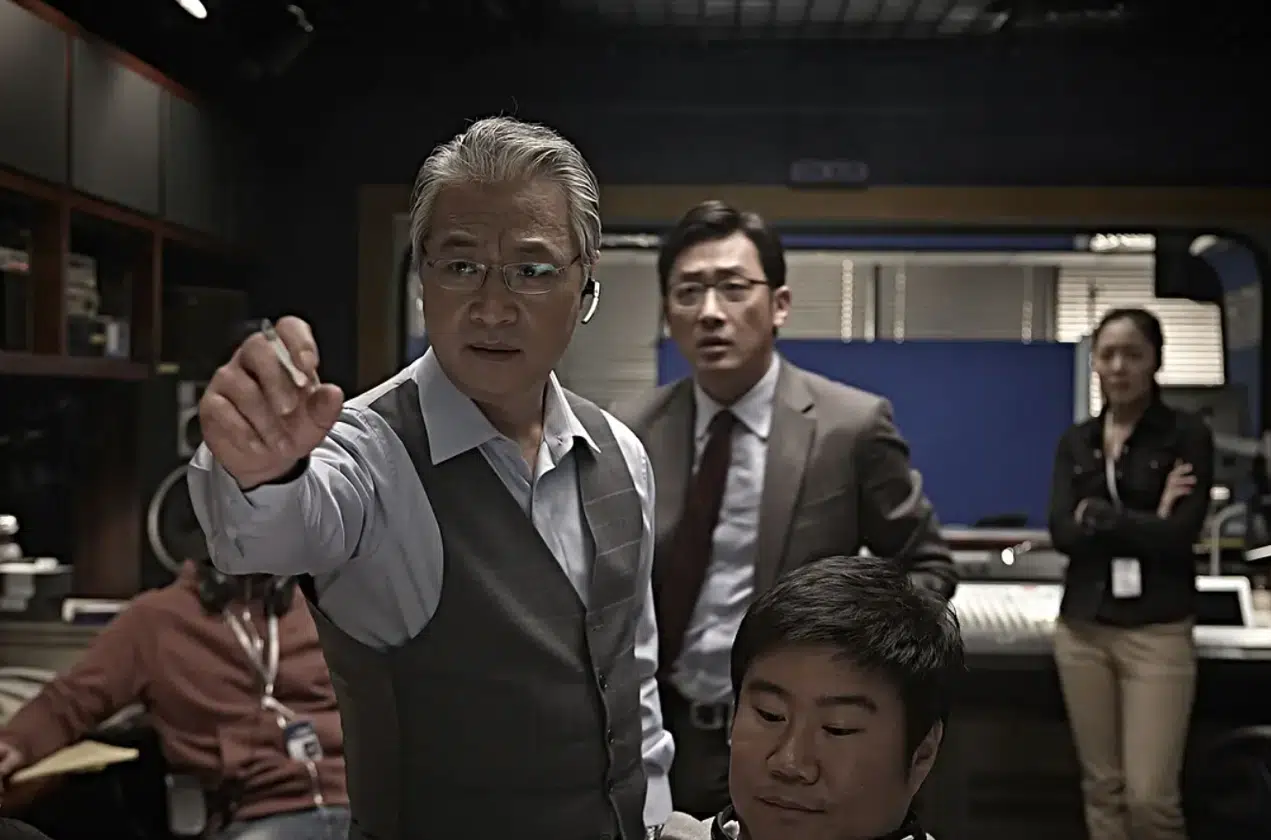
This implies that, in Kim Byung-woo’s view, not only are political power and media power tightly interwoven, but the political image itself is fabricated by the media. It’s an illusion, nonexistent. When a real person faces and fights against this nonexistent power, tragedy is inevitable.
Further, the media ostensibly represents the public’s interests and monitors the government. This is the idealized image of media worldwide. At the film’s start, Yoon Young-hwa invites the public to discuss the unfair tax system, embodying the media we imagine and want to believe in. But by the film’s end, we see that not only is the government’s image fabricated, but so is the media’s.
Thus, not only are political power and media power closely linked, but media power is also something to be subverted and resisted.
In the final shot, the always-on-camera anchor Yoon Young-hwa finally looks directly into the camera, facing us as the audience and the public for the first time. He transitions from a fabricated media image to a natural human being. This might be a comedic symbol in a tragic ending.
Hence, we understand why Kim Byung-woo chose this media-blending approach to tell the story and why he insisted on direct audience participation in the film's process.
Ultimately, what does "The Terror Live" subvert? The director uses genre film elements to subvert genre films. He blends different media expressions and ultimately subverts the media itself.




Share your thoughts!
Be the first to start the conversation.