
There is an inherent desire in the male population to understand the plight of womanhood, but also an inherent inability to dismantle that from their own identity. I saw this most evidently with readings on Hamnet.
Although I really enjoyed the movie, I remember walking out of the theatre feeling somewhat dissatisfied with the ending. I attempted to verbalize what I felt was missing but I felt like I wasn't quite able to point at exactly what bothered me. My first complaint was about how I wished we had less Shakespeare in the movie; the general response was laughter because, firstly, Shakespeare was barely in the movie as it is, and secondly, it's literally a movie about what later inspired Hamlet, a play that he wrote. My dissatisfaction was deemed a result of me being too feminist, as though that meant that I hated any male figure being the center of a story. Which is largely untrue.
I had to rethink long and hard what it was that I was feeling about this movie. Was it the way that it was cut? Was it the way they wrote the romance between Will and Agnes? I was one of the people who thought the romance in the beginning felt passive and anticlimactic. The passion mostly stemmed from Will and then formed an enclosure around her. I don't think it was far-fetched to argue that she was, in some ways, being domesticated by Will's love (the whole falcon imagery), but then, again, maybe I was over-reading it because many people disagreed. Many men, in particular, disagreed.
My second complaint was about the grieving process. I kept saying that Shakespeare failed his wife. He was barely doing the bare minimum; meanwhile, Agnes was sacrificing everything she had. When I vocalized this, I was met with arguments on how "it was just how things were back then," and that Shakespeare was doing the best he could. My dissatisfaction, therefore, was irrational because I just didn't get it. Which, of course, made me think harder.
Was that true? Were my feelings of discomfort largely in part because I was being too sensitive? Or was there something else that I was picking up on?
For some reason, I felt the need to dig my heels. I couldn't help it. Maybe it was the kinds of responses that I was getting: being taken aside to talk about how critiquing Shakespeare's behaviour was wrong because that individual resonated with how Will grieved. Being told that men and women grieve differently and that's okay. Well, sure, nobody grieves the same way, but that's a whole different discussion. My point is that I don't think the men I was talking to knew how to understand what I was saying without feeling offended. Which is a problem.
To an extent, I get it. It's funny because, to critique a narrative that, by extension, mirrors someone else's experiences or what someone else resonated with, can feel very much like pointing fingers and accusing them of their own faults. However, that wasn't my intention. A part of me still struggles to communicate that, and when I was talking about Hamnet, I weirdly felt like Agnes, kind of sideswept in this weird space of emotion and neglect. To be heard is one thing, to be understood is entirely another.
When I watch this movie, I know my experience is fundamentally different from others because my lived experiences are entirely different. So many women have been raised in an environment where the emotional burden lands on our shoulders; I, like so many women, resonate and can see the complexity of Agnes and Will's relationship because that is, to some extent, a reality. Even now. In these modern times. To ask for a narrative which relocates the female figure, which demands the male counterpart to sit in discomfort, or at the very least in the margins, shouldn't be an attack on all men because it's not.
The problem is that, in order to understand where I am coming from, it would mean understanding my experiences as a woman. It would mean admitting that male narratives already take up more space than female ones. That is what I realized my qualm was about; Hamnet is a branch off of the story of Hamlet. It was supposed to be the space where Agnes could express her grief entirely and loudly. It was the plight of motherhood, of the loss of a child and an entire identity. Hamnet was supposed to be the story of her loss.
For someone to come up to me and argue, "Oh well, Will had like one soliloquoy," is someone who has essentially missed the point of what I am saying. It's not about how many lines Will had, it's about where Agnes is located in the story. To look at me and think that my feminist gaze is over the top dramatic, again, ceaselessly undermines the experience in which I am talking about. Which is to say: it isn't about you.
It's about Agnes.
Where Is Agnes?
Agnes: My glove... My glove belongs to my mother. She stepped out of the forest, like her mother did and her mother before. Each got their skin locked in a door and handed a glove so that the desire from the sky could strike them while they held their sleeves against the howling spiders who had cut off their right hand. I don't need a new glove. This is my flesh. My skin. My hawk. I do not want something that does not even fit you.
The poetry in Hamnet begins with Agnes. From the red fabrics draping over her, to the first scene in the movie where she is both child and heart, the movie establishes whose story this is without even a word spoken. She is the beating pulse in the womb of nature, emerging as this untouchable, almost mythical creature, a marker of vitality, roaming the forest untouched and unseen until it is that Will sees her and everything changes.
On the one hand, pushing Agnes away from her feelings becomes this very on the nose way of showcasing how her identity as a woman, even in her own story, is constantly overwritten by her male counterpart. You have this character who, at first, was free. She was part of nature, free to roam as she pleased. And then, of course, with the falcon imagery, that freedom was quickly stripped away from her as she pursued her relationship with Will. As he takes her hand– or, if we want to be more literal with the metaphor, gloves her (I mean, he literally made her another glove)– she becomes domesticated, confined not only to him but to the boundaries of his childhood home.
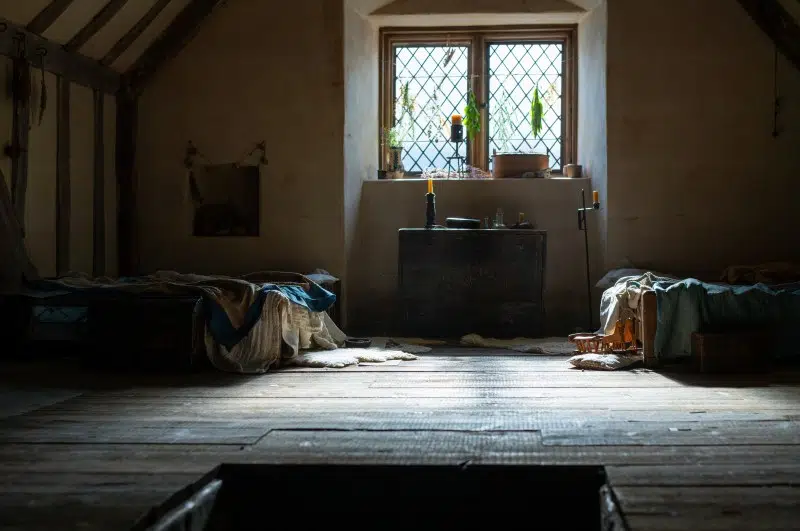
As a lifeforce, as this sole figure of creation who literally births their family, who reinstates passion in Will, Agnes should be at the centre of this tale. Hamnet relies on her to both exist and survive. Yet, instead, just like the rest of society, just like Will, the film clips her wings, too; it sidelines her, but in the weirdest way.
So, the first half of the movie is watching Agnes lose bits and pieces of herself and her freedom. The first time, is when she is kicked out of her home and put into Will's house. Then, it is when she sends Will to London. On the surface, both of these moments are posed as her decision; however, the issue is that each choice that she makes is at the sacrifice of her own wants and needs. There's even a line just before Will goes to London where he asks about the gender of the baby and we see the extent to how removed Agnes' has become from herself: "No. I have not had many dreams lately. I do not know why..." Later, when she has the traumatic birth with the twins, she deliriously looks at her mother-in-law and the maid and states: "Two of you standing at my deathbed... I always thought they would be my children... It turns out to be you..." Both of these lines might seem obvious in that they demonstrate how Agnes' skin has become locked in Will's door. As a mother and wife, her identity becomes more and more fragmented. Before, the forest protected her; now she must concede to the protection offered by Will's home. Her grief builds and extends long before the death of Hamnet, but it is forcibly prevented from entering the house itself. We see that in the way the river floods into the hallways during the birth scene, but Agnes is prevented from reaching it. Even birth brings death this time, inside of Will's childhood home; Agnes has to revive her stillborn daughter, battling against the course of nature to ensure her daughter's life. I mean, I don't believe in witchcraft or magic, but I was convinced that the reason the twins had a traumatic death was because even in his absence, Agnes is bound to Will's jesses.

Relocating the Female Body
By the time the movie lurched to Hamnet's inevitable death, I was ready for a switch-up in narrative. We've had this grieving mother, who has silently suffered and sacrificed all of herself to keep her family alive and well, and now I was ready for her to assert herself. I honestly thought that was where the movie was headed. I mean, Hamnet dies and suddenly we are faced with Agnes' anger. It was strangely refreshing to see her in the bedroom, looking down at her husband with cold, cruel eyes as he sought comfort and have her say: "You weren't here."
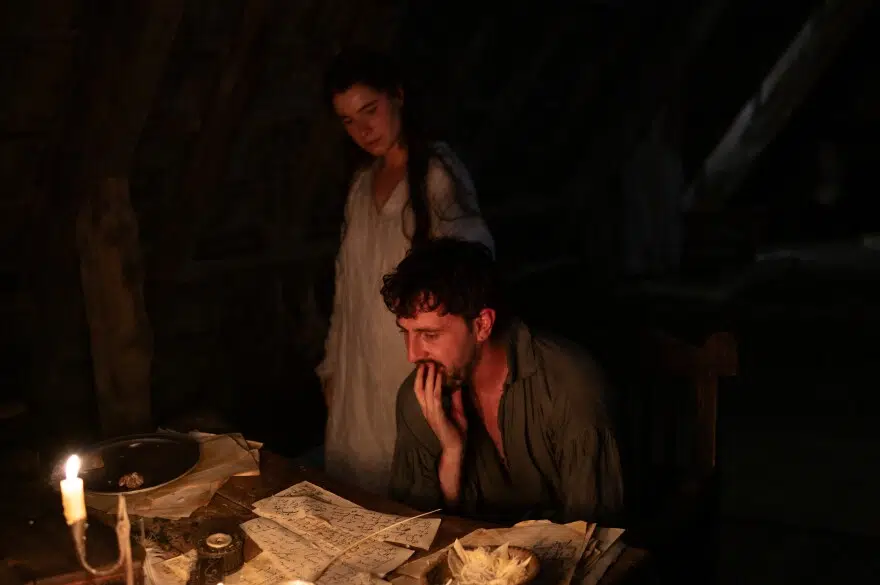
Then to have him acknowledge it and apologize was so perfect because it captured the essence of their relationship. To an extent, Will knew what he was doing and how much he had taken. He knew the weight of his absence on his family. For so long, Agnes had carried all of the emotional burden on her back. She gave and gave and got nothing in return. Finally, she speaks the truth. There is nothing more that she can give. Nothing more that Will can take.
The next logical direction for the narrative, then in my mind, would be to allow this anger and resentment to take over the screen. The movie does that a little bit when we have Agnes unable to forgive her husband and he basically moves away to London permanently, but then we also have Will's grief overtake Agnes'.
The story starts focusing on how he not only feels the loss of his son, but the loss of his family. More than Agnes' emotions, the movie pivots towards showing Will's grief of having his grief unseen by his wife. It's not a blatant shift, but I could feel it in the way that Agnes' sorrow started getting eaten up by Will's. We started getting more shots of him writing and rehearsing his play. Sitting in the room, backstage, sobbing. The long "To be or not to be" soliloquies where Will spells out how much pain he is in.
Not to be a misandrist or anything, but we get it Will. You're sensitive.
I don't need to see the grown man cry to know he's hurting: the existence of Hamlet already does that. In fact, the whole movie has been about trying to protect his feelings over anything. What I wanted to see was Agnes surviving. I wanted her to take over the narrative, to showcase what even Hamlet could not describe but could see. There was a grand miscommunication that separated the two from one another, a valley of different experiences that could not be translated or spoken or explained, and while Shakespeare ultimately found space to express it, Agnes never truly did.
Instead of those long, bland scenes of Will basically displacing his guilt and shame on his actors, it would have been so much cooler to see young Hamnet's ghost haunting Agnes. Then, to have Will witness this degradation of her sanity and using that to propel his artform would have been so much more impactful. I mean, then we'd at least get space to critique whose story and whose grief Hamlet depicts. I'm not asking for another hour and a half of Agnes wailing into a room, but at the very least, show us how grief affects her. Show us how she rebuilds an identity now that so much of her has been lost. To be or not to be, that is the question that haunts her and she never even gets the chance to truly ask it.
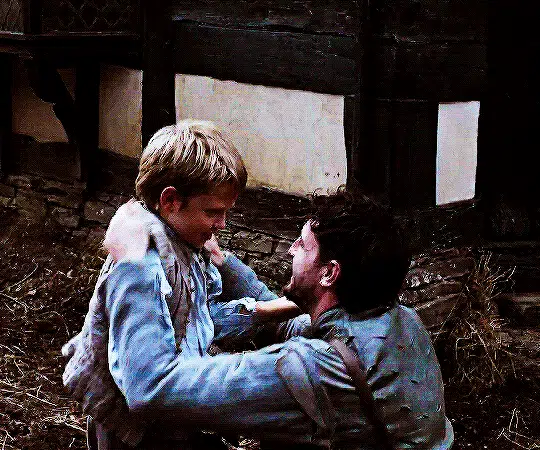
Contrary to what you'd expect, I'm not even asking for Will to disappear entirely from the story. All I am saying is to allow him to stay in the margins. Allow him to witness and observe his wife, for the rest of the story be an attempt to try to come back to her, try to rectify the mistakes he made. When all else fails, he'll resort to writing Hamlet as refuge from his woes. Then the play makes sense being a tool to reunite the two, later when Agnes finally begins to heal a little bit.
As of now, in the end, when they finally lock eyes across the stage, it doesn't feel like a full circle. It just feels like Will is getting praised for doing the bare minimum. That, after everything they'd been through, Agnes could finally recognize his grief, too. Which, guys... like, hello? That was the issue in the first place: he was so wrapped up in his own feelings and stuff that he never noticed hers. Agnes never had that problem. She was always attuned to him. We didn't need her understanding or acceptance. What we needed was a breath of fresh air; Will sees her and understands. Will goes out of his way to give her what she needs. And, no, a play is not the answer.





Share your thoughts!
Be the first to start the conversation.