
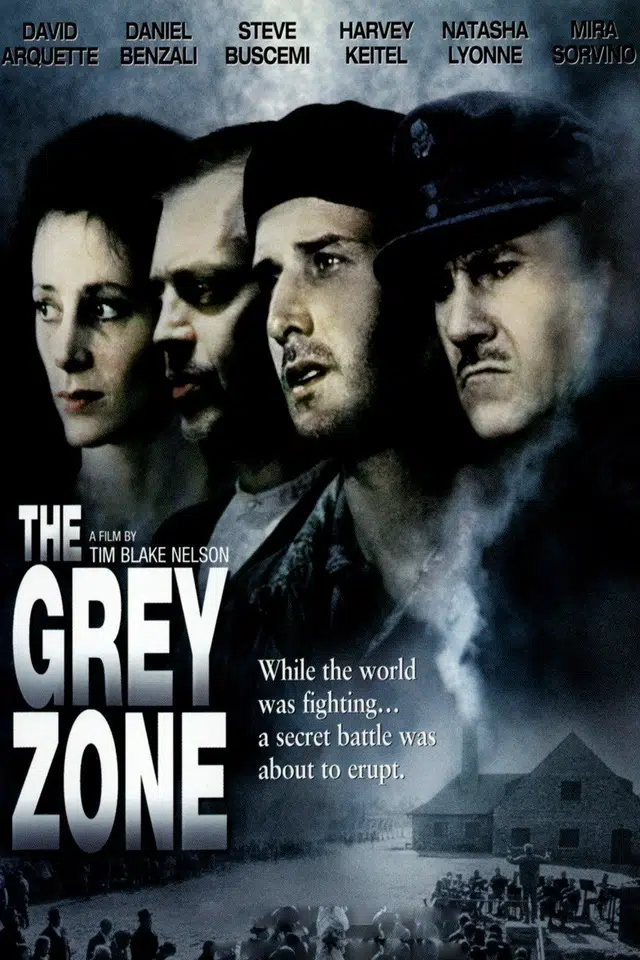
The Grey Zone explores a rarely told aspect of the Holocaust. It focuses on the experiences of the Sonderkommando, a small group of Jewish prisoners who were recruited to help the Nazis in the Auschwitz death camp. These men were charged with performing the most horrific & stomach turning duties involved in the process of exterminating their fellow Jews. They took part in chores such as ushering train loads of unsuspecting prisoners into the gas chambers. After the killings the men also had to cremate & dispose of the bodies. In return for their labor members of the Sonderkommando were afforded a short reprieve from death as well as physical comforts such as adequate food & clean sheets, both of which were unheard of in the rest of the camp.
It goes without saying that films dealing with the horrors of the Holocaust aren't supposed to be uplifting or happy go lucky but The Grey Zone certainly raises the bar on the theme of futility & hopelessness. The film's subject matter is dark & brutal. The prisoners are aware that their reprieve from death is brief, a mere matter of months. Furthermore, as one character points out, after the horrors he has witnessed & taken part in he wouldn't want to live after the war even if that was indeed a possibility.
Great films about the atrocities of Nazi Germany & World War II include some truly powerful films. Schindler's List, Life is Beautiful, & The Pianist are just 3 examples of excellent movies on the Holocaust. The talented filmmakers behind such films were able to tell narratives involving horrific cruelty & yet use this material to convey powerful human stories of survival, loss, & even love. Unfortunately The Grey Zone falls short of such genre classics.
Director Tim Blake Nelson adapted his own play for the big screen which may explain why The Grey Zone feels stagey & stilted at times. In order to translate the play into the cinematic medium Nelson has obviously fleshed out the material by inserting new visual content. Because of this there are an array of short scenes with no dialogue that seem out of context or unrelated to the narrative. Examples of this include a short sequence in which a group of unidentified prisoners are marched out & systematically shot. There's also a brief scene in which the camera lingers on an unknown guard taking a drink. Both of these are examples of visuals which seem out of place & aren't sufficiently explained within the film's storyline.
The Grey Zone features a cast that includes Steve Buscemi, Natasha Lyonne, Harvey Keitel, David Arquette, & Mira Sorvino. All of the actors do adequate jobs with the tragic material they are given. The only exception is vetern bad guy Keitel as Muhsfeldt, the camp commander. His characterization comes across like a bad Hitler imitation.
The film is based on the true story of the experiences of a renowned Jewish doctor who helped the Nazis with their gruesome medical research experiments in exchange for his life as well as that of his wife & daughter. The Grey Zone makes the assertion that when faced with death a person's basic survival instincts take over. Individuals in mortal peril will strike deals with the devil & commit previously unimaginable acts in order to keep on living.
One of the most powerful moments in the film occurs when a train load of unsuspecting Jewish prisoners are forced to disembark & line up enroute to the gas chamber. The weary passengers arrive at the camp complete with their meager possessions unaware of the fate that awaits them. In order to avoid mass panic & resistance the Nazis create an atmosphere meant to suppress the prisoners' fears. The area surrounding the gas chamber is dominated by a well maintained lawn & a ragtag band of prisoners deceptively plays pleasant music as hundreds of doomed people are herded onward to their deaths.
Once inside the “showers” the prisoners cooperating with their captors assure the newcomers that they have nothing to fear. They explain that the showering process is just a means of maintaining hygiene. By using fellow Jews to lie to the prisoners the Nazis make the members of the Sonderkommando accessories to mass murder. Keitel's character, Muhsfeldt, even says at one point in the film that he never hated the Jewish people until he saw how quickly they turned on their own & aided the Nazis in the extermination process.
This isn't a film for the faint of heart. It's brutal & unrelentingly hopeless. The Grey Zone presents a world in which death is a daily & commonplace reality. Victims lose their humanity & become unidentified bodies which must be incinerated & dumped. The horror in the film is expressed not only visually but also emotionally as in the scene in which we witness a group of prisoners being locked up inside the gas chamber. Viewers are spared shots of the actual gassing process. Instead we hear the agonized screams of the human beings trapped & dying inside.
The Grey Zone focuses on hopelessness & futility. Even in their brief act of defiance the members of the Sonderkommando are doomed. All actions to save themselves or others are ultimately pointless & perhaps that's what the filmmaker is trying to express; the hellish nature of a world gone mad.
The Grey Zone is a hard movie to watch as it recreates unimaginable horrors perpetrated by the Nazi regime. As a film it falls short because we, as viewers, get no real sense of the individual characters portrayed in the movie or their morality. Ultimately at the end the movie viewers learn nothing & are left cold & consumed by sadness & horror.
Originally published on Helium.




Share your thoughts!
Be the first to start the conversation.