
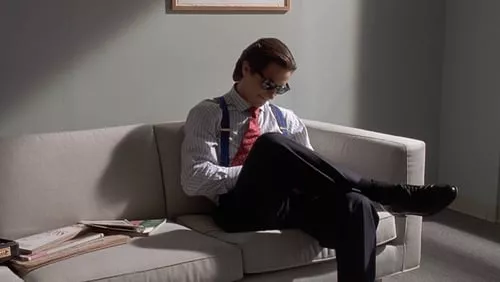
Released in 2000, "American Psycho" is a quintessential satire of American consumer culture and materialism, as well as a brilliant exploration of narcissistic personality disorder. Set in the 1980s, the film captures the rise of yuppie culture. In this era, urban elites, often well-educated and affluent, placed immense value on the aesthetics of their lifestyle, from clothing to dining.
Exaggerated Facades and Hollow Interiors
Early in the film, the camera takes us into a luxurious apartment. The protagonist introduces himself: "I live in the American Gardens building on West 81st Street, on the 11th floor. My name is Patrick Bateman. I'm 27 years old. I believe in taking care of myself with a balanced diet and rigorous exercise routine…" Bateman details his skincare regimen, meticulously listing the products he uses. In the original novel, his dental care alone involves six different brands, and his hair care routine is even more elaborate, involving eight brands.
As Bateman gazes into the mirror, he muses, "There is an idea of a Patrick Bateman, some abstraction, but there is no real me, only an entity, something illusory. And though I can hide my cold gaze, you can shake my hand and feel flesh gripping yours, and maybe you can even sense our lifestyles are probably comparable... I am not there."
This passage sharply captures the core traits of a narcissistic personality: a grandiose façade masking an empty inner world. One scene in the film symbolizes this dichotomy perfectly, as Bateman's perfectly groomed face is reflected alongside a poster for "Les Misérables." The term narcissism comes from the Greek myth of Narcissus, who fell in love with his reflection in a pool of water, gazing at it in rapturous delight until he died, turning into a daffodil by the water's edge. Bateman, similarly, is obsessed with his reflection. Narcissists often exhibit self-centeredness, excessive talking, and a desperate need for admiration and envy from those around them. Yet, as we better understand such individuals, we realize that their exaggerated expressions are often a defense mechanism. Psychologist Heinz Kohut described these individuals as "tragic men" because a deep sense of defectiveness, fragmentation, and inner emptiness lies beneath the grandiosity.
When interacting with such people, we often feel bored, ashamed, frustrated, or envious—emotions they are desperate to avoid but inadvertently project onto others. Many psychological theories suggest that such individuals often lack adequate nurturing during childhood—nurturing that involves understanding, care, recognition, and respect, especially treating the child as a unique individual rather than valuing them solely for their external achievements.

Our societal and cultural context also plays a role in exacerbating these traits. In an era where money, material success, and individual achievements are highly prized, narcissistic tendencies may serve an adaptive function. Social interactions have become faster-paced, and individuals are often treated as mere tools. As Bateman's monologue suggests, Patrick Bateman is just an idea, an abstraction. In his broader critique of societal systems, Herbert Marcuse elucidated this concept in One-Dimensional Man: "People recognize themselves in their commodities; they find their soul in their automobile, hi-fi set, split-level home, kitchen equipment."
Narcissistic Rage
In one of the film's most exaggerated and satirical scenes, we catch a glimpse of another striking trait of narcissistic personalities—narcissistic rage. Patrick Bateman and his friends compete over whose business card is the most tasteful. As Bateman gazes at a colleague's card, his inner turmoil is palpable: "Look at that subtle off-white coloring, the tasteful thickness of it. Oh my God, it even has a watermark." The very next scene shows Bateman murdering a disheveled, impoverished homeless man.
Despite their outward projection of confidence and boasting, those with narcissistic personalities possess a fragile sense of self-esteem. They are particularly fearful of humiliation. When Bateman perceives his business card as inferior, he feels a deep, humiliating anger. He channels this emotion by finding the homeless man and transferring his feelings of worthlessness and inferiority onto him.
The act of murder is triggered when the homeless man accidentally touches Bateman. Symbolically, this might represent Bateman's confrontation with his own perceived worthlessness—an encounter so unbearable that his narcissism collapses, leading him to kill. But murdering the homeless man isn't enough; Bateman must also eliminate the colleague who made him feel humiliated. As he dons a transparent raincoat and gleefully swings an axe, he is momentarily free from feelings of worthlessness, his sense of omnipotence and grandiosity restored. This cycle of rage and violence may explain the stubbornness of narcissistic traits; in a twisted way, they serve as a defense against overwhelming shame, depression, and suicidal despair.
Inability to Form Deep Relationships
The film also vividly illustrates Bateman's lack of empathy and exploitative nature in his interactions with his lover, secretary, and prostitutes. He is solely concerned with his feelings. This is visually emphasized through the use of mirrors in various scenes. For instance, when his lover tries to express her feelings, Bateman looks at himself in the mirror and remarks, "What a handsome guy." Similarly, during an encounter with a prostitute, he is more interested in admiring his reflection than in the act itself.
People with narcissistic personalities struggle to form deep and emotionally meaningful relationships because they find it difficult to rely on others, express genuine remorse, or feel gratitude. Dependence on others suggests a need for something one lacks, triggering feelings of vulnerability and shame.
Dependence and vulnerability are essential for building sincere, deep relationships. Unfortunately, the more one fails to form such connections, the more one feels empty and fragile. This increases reliance on grandiose defenses, creating a vicious cycle. As the film progresses, Bateman's descent into violence and his total disconnection from others culminate in his mental breakdown. In a profoundly ironic twist, when Bateman finally seeks help from his lawyer, the lawyer tells him that none of the murders happened, that it was all in his head. The film ends with Bateman's hollow gaze—a moment of actual destruction, a psychological murder. This film's most terrifying scene represents a plunge into an endless abyss.
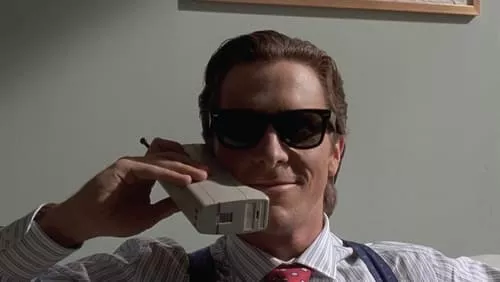
Narcissism exists on a spectrum across different personality levels, with varying degrees of severity. Narcissistic Personality Disorder is the most extreme manifestation of this pathology. Still, all of us possess some narcissistic traits to a certain extent, and we've all experienced moments of narcissistic injury. Some aspects of the film, like the competition over business cards, may seem exaggerated, but who among us hasn't felt the fear of being judged by external markers of worth? When our value collapses into a mere outward display, and our relationships become dominated by comparison, the film offers a stark warning.
To be human is to be imperfect. If we cannot accept imperfection, we risk becoming like Bateman—a hollow, abstract person, ultimately losing our true self. It brings to mind Fyodor Dostoevsky's words: "Love people in their specificity, not in their abstraction." Let that be a shared reminder.




¡Comparte lo que piensas!
Sé la primera persona en comenzar una conversación.