
Two years after Asteroid City, Wes Anderson returns with The Phoenician Scheme, a film that showcases his familiar style but ventures into uncharted emotional and philosophical territory for the director. Set against sun-drenched deserts and aging empires, this is still very much Anderson in style – symmetrical compositions, deadpan humour, meticulous mise-en-scène, and chapter titles abound – but these flourishes are applied with a more subdued brush. It may not be as visually flamboyant as The Grand Budapest Hotel or even Asteroid City, but what it lacks in maximalist whimsy, it gains in thematic weight. This is Anderson filtered through a darker lens, one where style no longer cushions emotion but sharpens it. It is a satire with a deeper, murkier sense of moral reckoning.
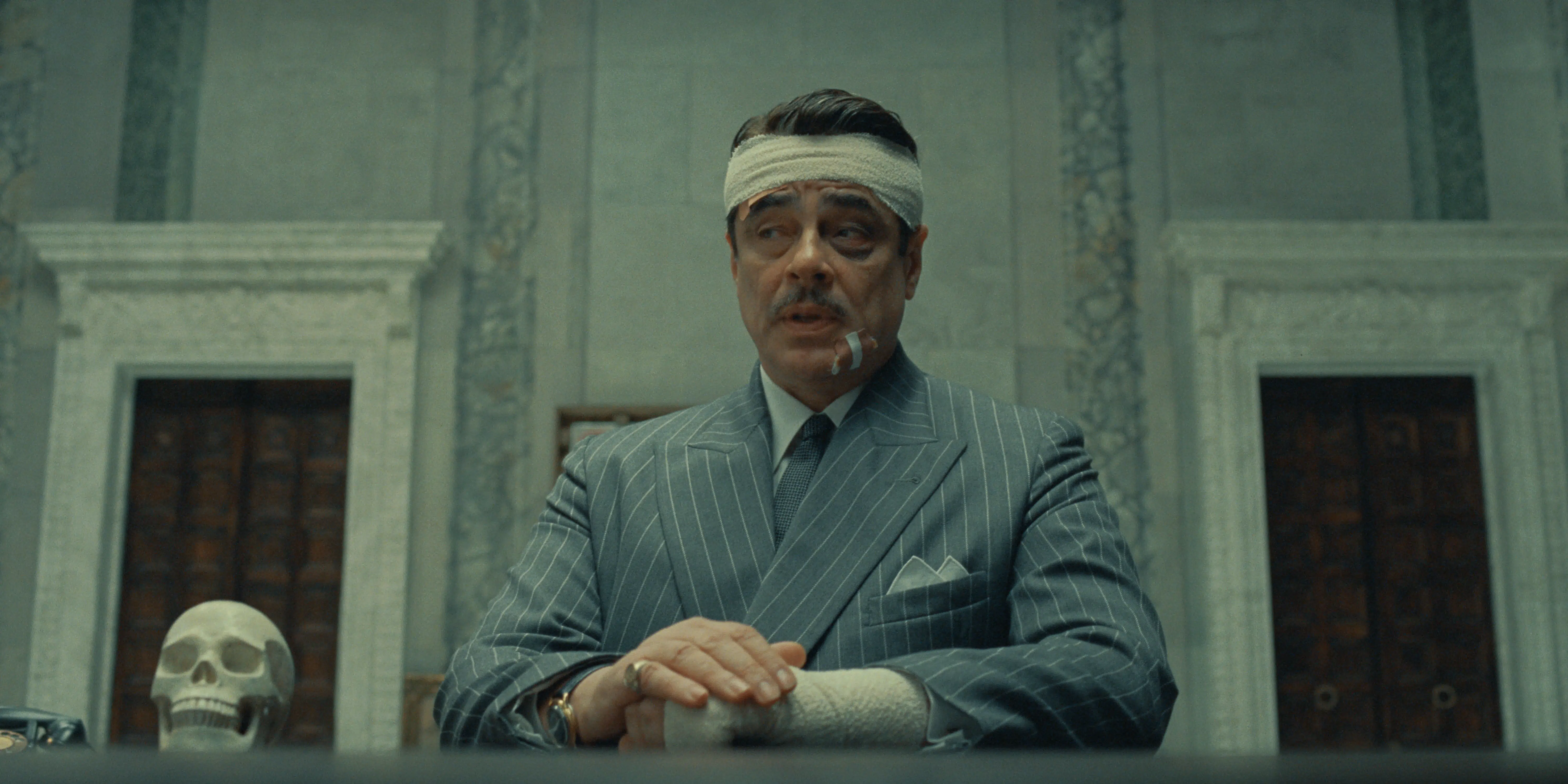
At the center of the story is Anatole “Zsa-Zsa” Korda (Benicio Del Toro), a world-weary arms magnate and industrialist whose survival defies probability – six plane crashes and countless assassination attempts have failed to kill him. But when one more in-flight assassination momentarily succeeds, leaving Korda technically dead, he is whisked to a purgatory tribunal. In what feels like a nod to Heaven Can Wait (1943), the tribunal is less interested in his crimes than in whether there’s any part of him left to save. The moment is absurd, ironic, and quietly chilling. It is classic Anderson in tone but shot with existential dread.
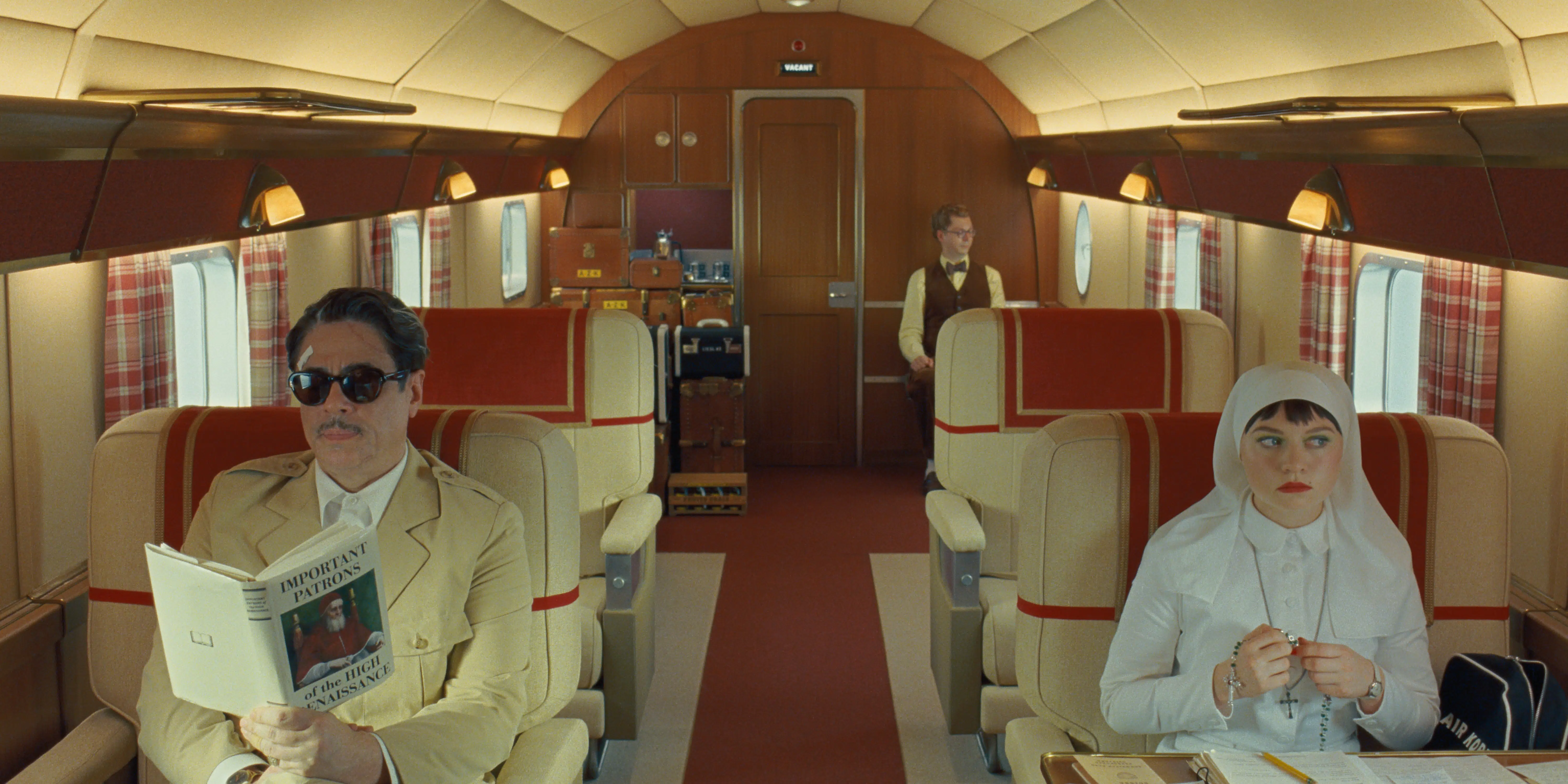
What follows is not a redemptive arc in the traditional sense, but a slow-burning, ethically murky attempt at reconciliation. Shaken by his near-death, Korda resolves to make amends by reuniting with his estranged daughter, Liesl (Mia Threapleton), a devout novice nun who wants nothing from him. His motives are not purely noble; he hopes Liesl will abandon the convent and inherit his decaying industrial empire, part of a morally ambiguous project to exploit a resource-rich Phoenician territory. Thus begins one of Anderson’s most layered familial narratives – not a quest for redemption so much as a negotiation of spiritual debt.
Anderson has always been fascinated with families – from The Royal Tenenbaums to The Life Aquatic with Steve Zissou and The Darjeeling Limited. Bad dads, especially, are a recurring element in his filmography. Korda fits this mould precisely: emotionally unavailable, ethically compromised, and now, perhaps too late, reaching for a bond he long neglected. What separates Korda from his predecessors is the added spiritual weight of his estrangement – a man who doesn’t just want to reconnect with his daughter, but who needs her to believe he can still be saved.
This film doesn’t offer reconciliation in the form of tearful reunions or grand gestures. Instead, the emotional evolution between father and daughter unfolds with absurd hijinks involving jungle militants, industrial espionage, basketball games, and numerous bugs. Their interactions are awkward, formal, and even hostile at first. And yet, Anderson draws something affecting from the restraint. The real emotion seeps through the quiet, not in what is said, but in what isn’t.

Liesl, portrayed by Threapleton in her first leading role, becomes the soul of the film. She is not naïve, but deliberate – someone who has chosen faith and simplicity over the chaos of power. Her journey is about more than reconnecting with her father; it’s a process of spiritual discernment, reckoning with the sins of a man who helped shape the world she’s tried to escape. Through Liesl’s eyes, we learn about the mysterious death of her mother and the corruption embedded in Korda’s empire.
One of the most remarkable aspects of The Phoenician Scheme is the way Anderson’s visual grammar evolves to match his darker material. The famed symmetry is still present, but here it conveys sterility more than charm – a kind of emotional repression. The sets are immaculate but desolate. Korda’s palace is all brutalist lines and fading opulence; the desert construction sites hum with slow, bureaucratic menace. Anderson’s production design, always a character in itself, is weaponized here to highlight the moral rot at the heart of this empire on the brink of death.
The palette is bleached and parched, dominated by ochres, rusts, and sunburnt whites. This minimalism marks a departure from the vibrant colour schemes of many of his other works, underscoring the film’s emotional desolation. Still, Anderson’s signature techniques remain – the whip-pans, the flat staging, the playful use of chapter headings and miniatures – but they carry a new weight. They don’t comfort the viewer here; they distance, challenge, and provoke. Style becomes a moral architecture: the world is beautiful, yes, but it is also rigid, unyielding, and indifferent.
Del Toro is an inspired choice for Korda – his brooding intensity and sardonic wit allow him to both embody and subvert the archetype of the untouchable tycoon. His performance is restrained yet haunted, capturing a man whose survival has become a kind of curse. Del Toro’s Korda is never fully sympathetic, but that’s the point: The question is not whether he can be loved, but whether he can be saved.
Threapleton’s Liesl is a revelation. Clear-eyed, emotionally precise, and commanding in her stillness. She brings a quiet gravity that anchors the film’s emotional stakes. Together, Del Toro and Threapleton create a dynamic that is less about reconciliation than reckoning; two souls circling one another, uncertain if they can share the same moral universe.
Michael Cera, as the endearingly awkward tutor Bjørn, brings much-needed levity. His role, a third wheel to Threapleton and Del Toro, provides a crucial tonal counterbalance. Bjørn’s bumbling sincerity contrasts with Korda’s cold calculation, making him a surrogate for the audience, observing, bewildered, and gently empathic. The rest of the cast is an ensemble of familiar faces in Wes Anderson's repertoire: Bill Murray, Willem Dafoe, Scarlett Johansson, Jeffrey Wright, and Tom Hanks, among others, all lend their familiar gravitas to this world.
The Phoenician Scheme is Anderson’s most openly political film to date. Beneath the family drama is a scathing satire of capitalism, imperialism, and the seductive power of wealth. Korda is the avatar of the modern billionaire: untouchable, godless, and insulated from consequence. The question the film poses is whether a man like Korda can ever truly change. Is redemption even possible for those who shaped systems of harm? Liesl, for her part, is unsure. Her faith doesn’t offer easy answers. The final image – a quiet card game between father and daughter – is deceptively simple, but it crystallizes the film’s core tension: Can connection exist without absolution?
The Phoenician Scheme may not win over all Anderson fans. It is much less vibrant visually and narratively and much harder to follow than most of his other works, but it is also one of his most urgent and mature films – a work that trades the comfort of whimsy for the discomfort of reality.
This is Anderson at possibly his most reflective. The Phoenician Scheme doesn’t offer neat resolutions or sentimental catharsis. Instead, it leaves us with questions about legacy, faith, family, and a stark reminder that even the most symmetrical frame can contain a broken world. Just when you think you have Anderson down, he shifts and changes. This evolution may not be a smooth ride, but it’s one that always entices you to be seated.






Share your thoughts!
Be the first to start the conversation.